
Go Artefacts in Britain
This page lists Go artefacts in Britain, for example exhibits in museums and stately homes. It includes paintings, furniture, porcelain and of course Go equipment. If you discover something not listed then let us know and include any photographs or web links. A list of Japanese collections in British museums is held at the Japanese Embassy site.
Note: museums usually have large collections that are not permanently on display and items are often rotated, so there is no guarantee to see anything listed below. If you want a quick look at items displayed have a look at photos of artefacts.
Museums
British Museum, London
Photos of Go ban, prints and netsuke copyright of Trustees of the British Museum
|
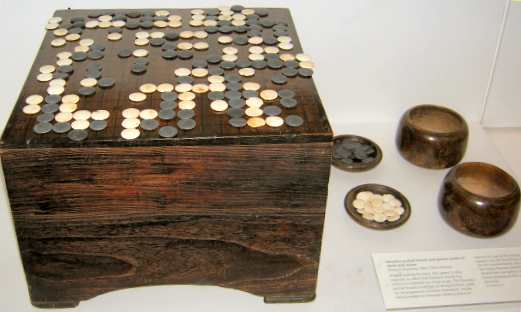
On level 2, in the Korea room, is an exhibit captioned “wooden paduk board and pieces made of shell and stone”, which is an interesting Korean board, specifically an 18th–19th Century Sunjang Baduk board, hollow with tensioning wires underneath to make it resonate when played on. There are bowls and slate and shell stones of similar age. Sensei’s Library has an article about Sunjang Baduk. |
 |
|
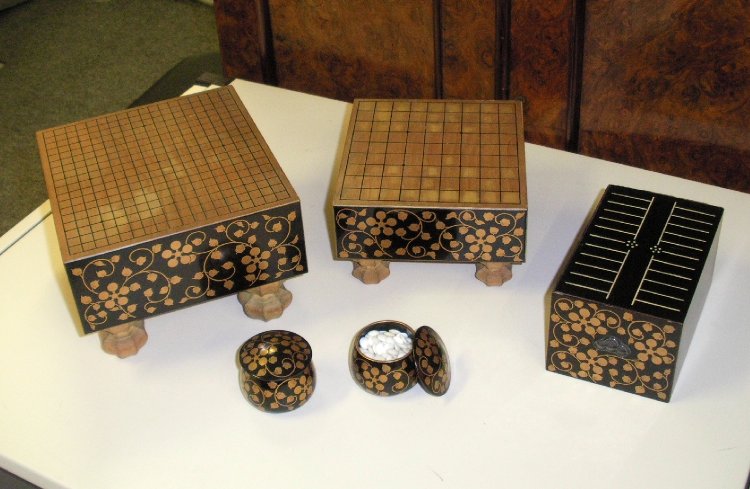
There is in their collection a 19th Century Japanese Go ban, with gold on black floral decoration around the sides, and matching bowls. It is part of a set with a Shogi board and Sugoroku (backgammon) board decorated the same way. |
 |
|
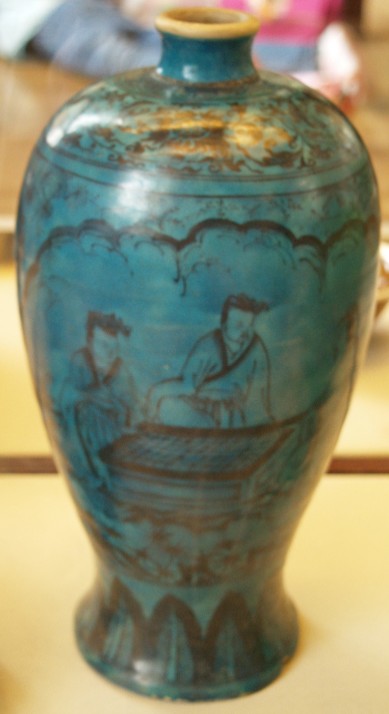
In the Chinese collection is a Cizhou-type Ming stoneware vase from the 15th Century. It is about 30 cm high and is decorated in black enamels under a turquoise glaze. It shows the immortals at pursuits such as music (on back) and Go (two men play as a third watches). A larger vase features Chinese Chess. Neither were on display in Autumn 2011. |
 |
|
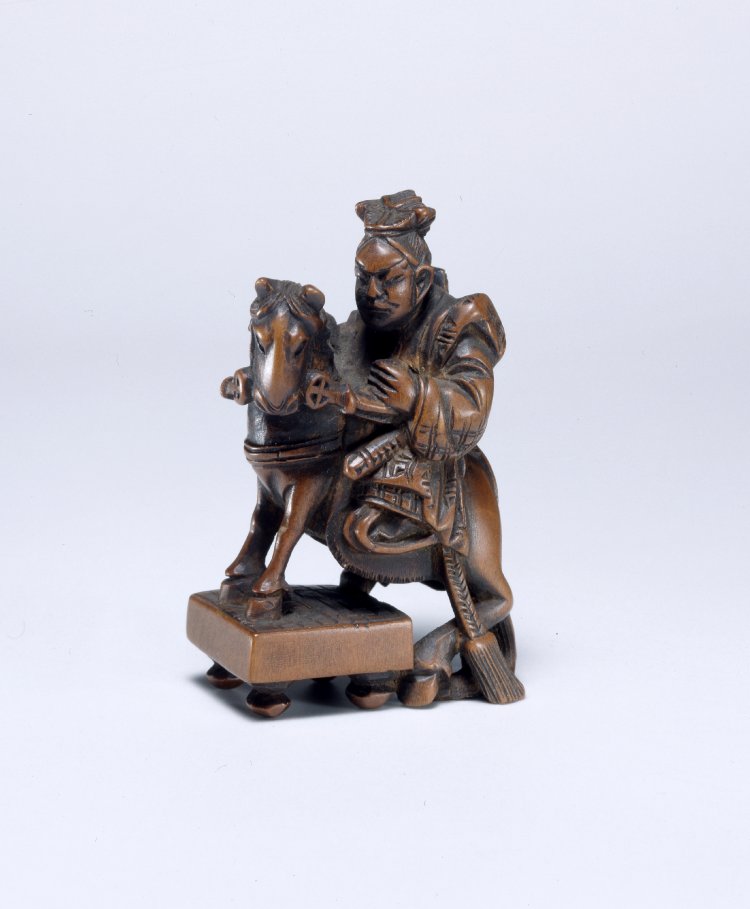
There is a large collection of Japanese netsuke (mostly not on display), seven featuring Go. Four of them are carved in the shape of hollow fruit (such as a peach, orange or persimmon), with two or more figures grouped around a Go ban inside. Another is just a carving of men playing Go, whilst two are carvings of the famous horse and rider on Go ban (as in the picture). |
 |
|
There is also a 15 cm white porcelain Chinese plate from the late 18th century with overglaze enamels and gilding. A man and woman play, while a third watches. A similar plate shows Chinese Chess with tall pieces. These plates formed part of the "China: Journey to the East" exhibition that visited Bristol Museum in early 2009 | 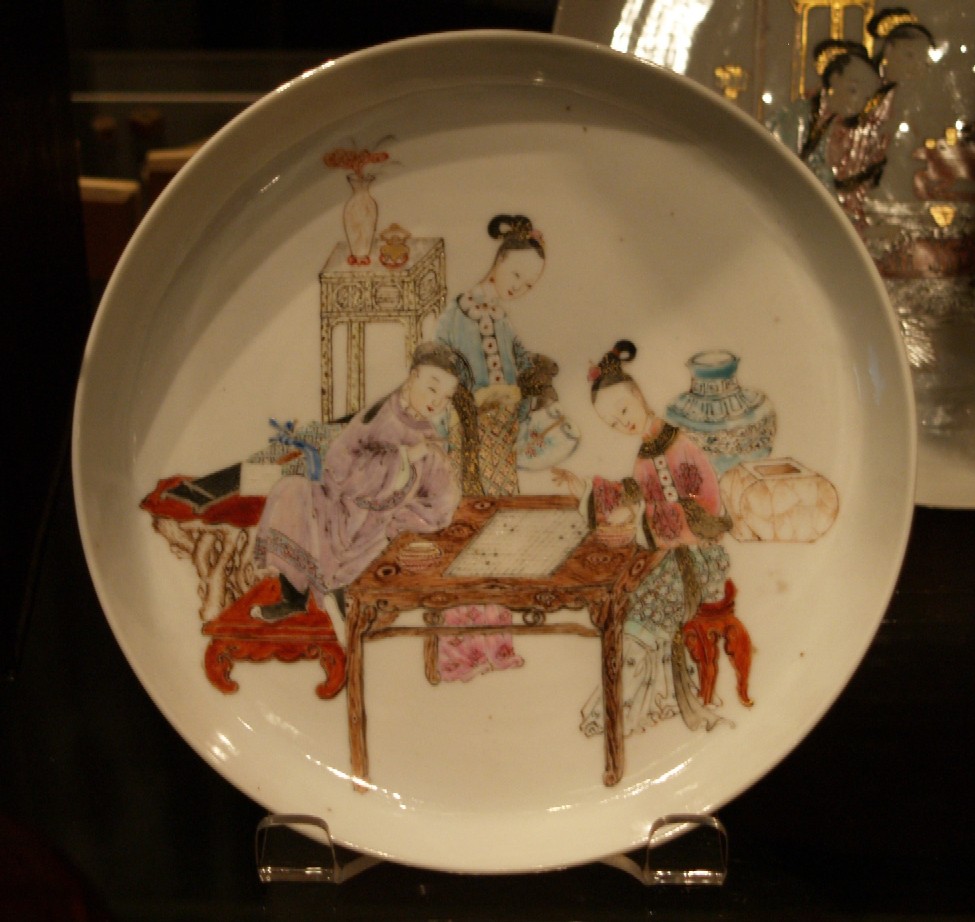 |
|
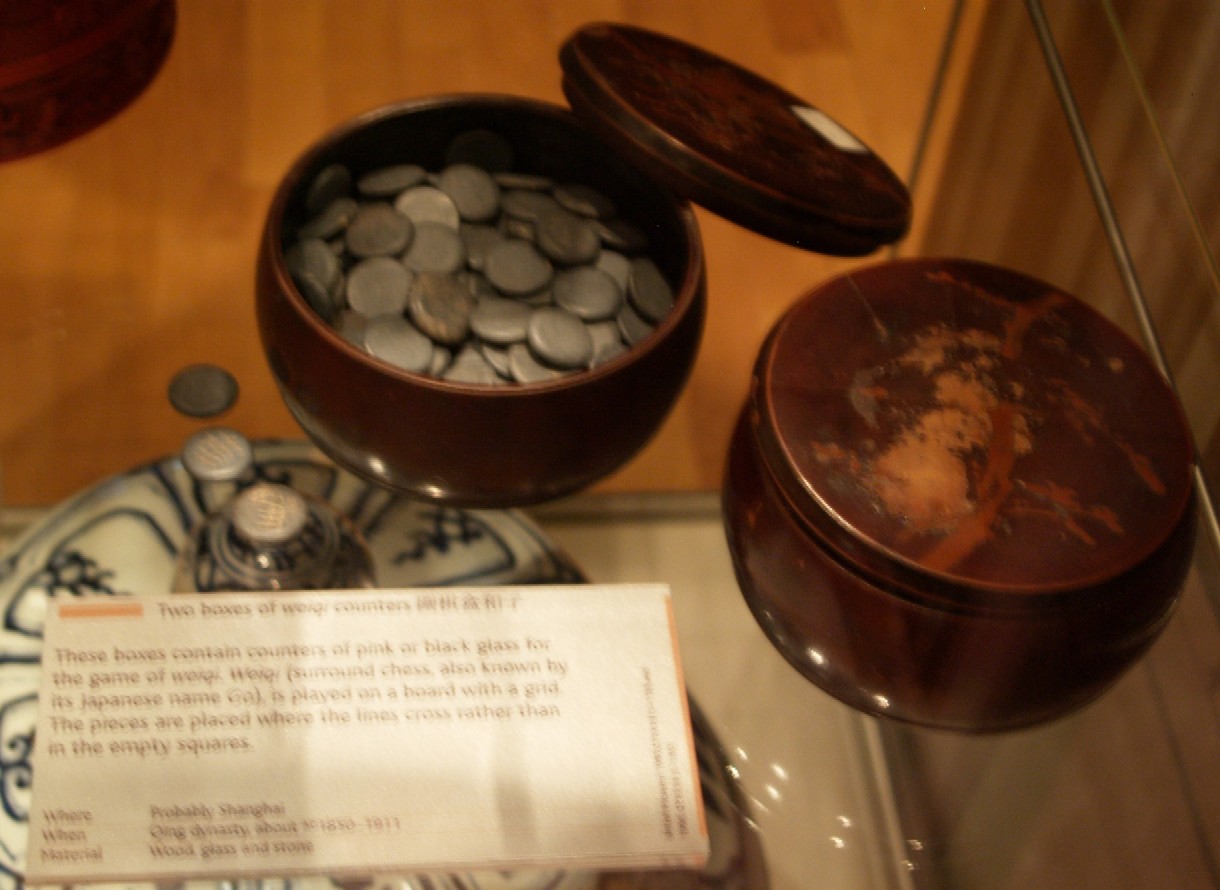
The games collection has a 19th Century set of stones from Shanghai. The stones are small (about 1 cm diameter) and have Chinese characters on their face. They are contained in brown wooden bowls with patterned lids. These stones also formed part of the "China: Journey to the East" exhibition that visited Bristol Museum in early 2009. |
 |
| Also in the collection are two tsuba (Japanese sword guards); one shows Tadonobu hurling a Go board and the other sages reading and playing Go. | |
|
Other objects are in the games collection, part of which toured the UK in 2005-2007 as the Across the Board exhibition. |
|
|
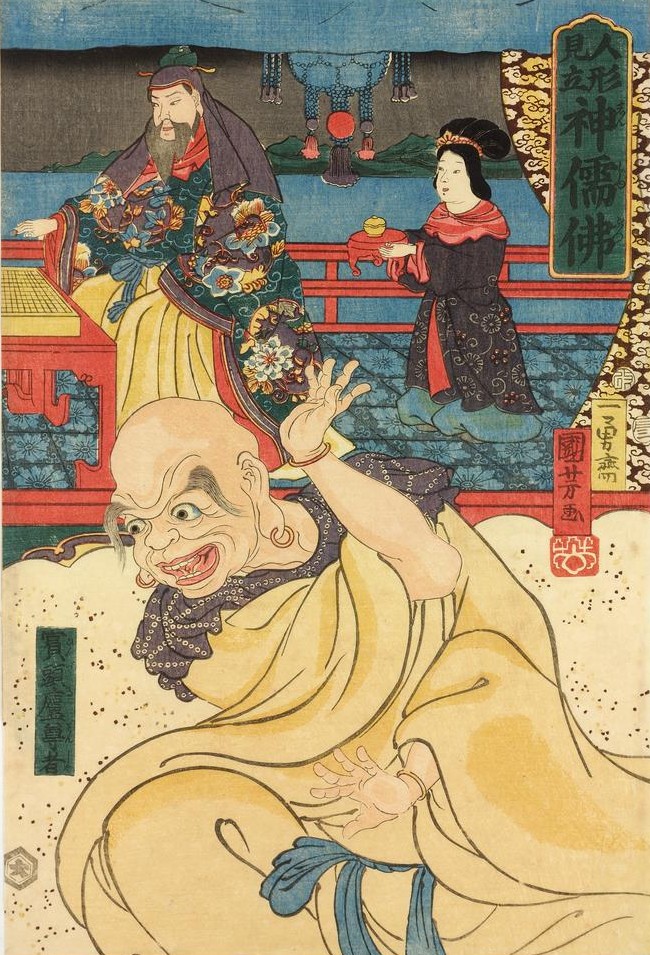
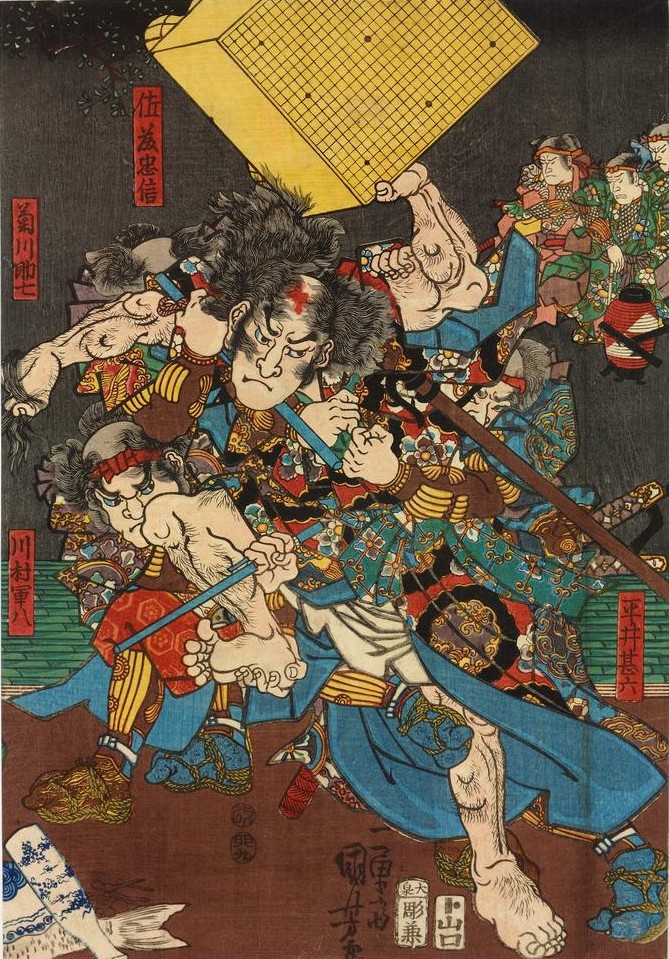
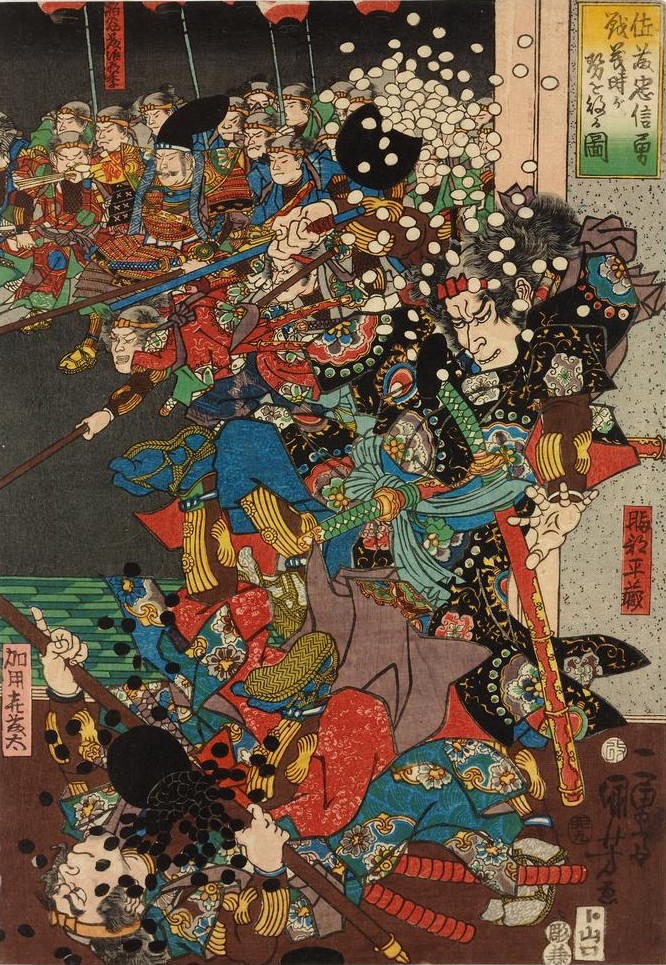
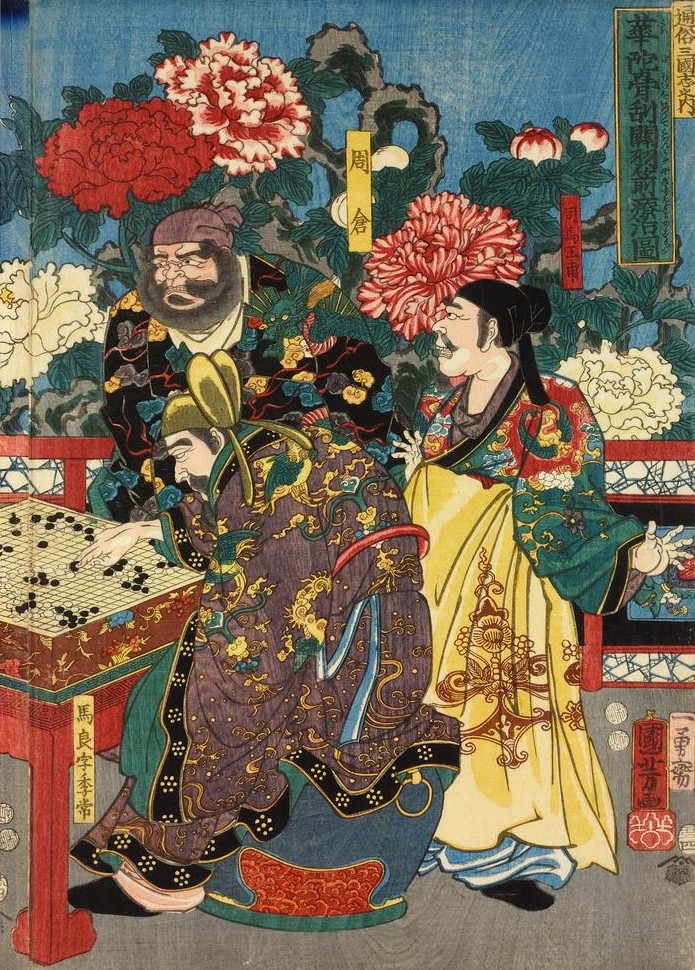
The British Museum has a collection of Wood Block Prints (Ukiyo-e) some of which show Go images. A file of images of some of the prints has been provided to us by print-collector Erwin Gerstorfer. | 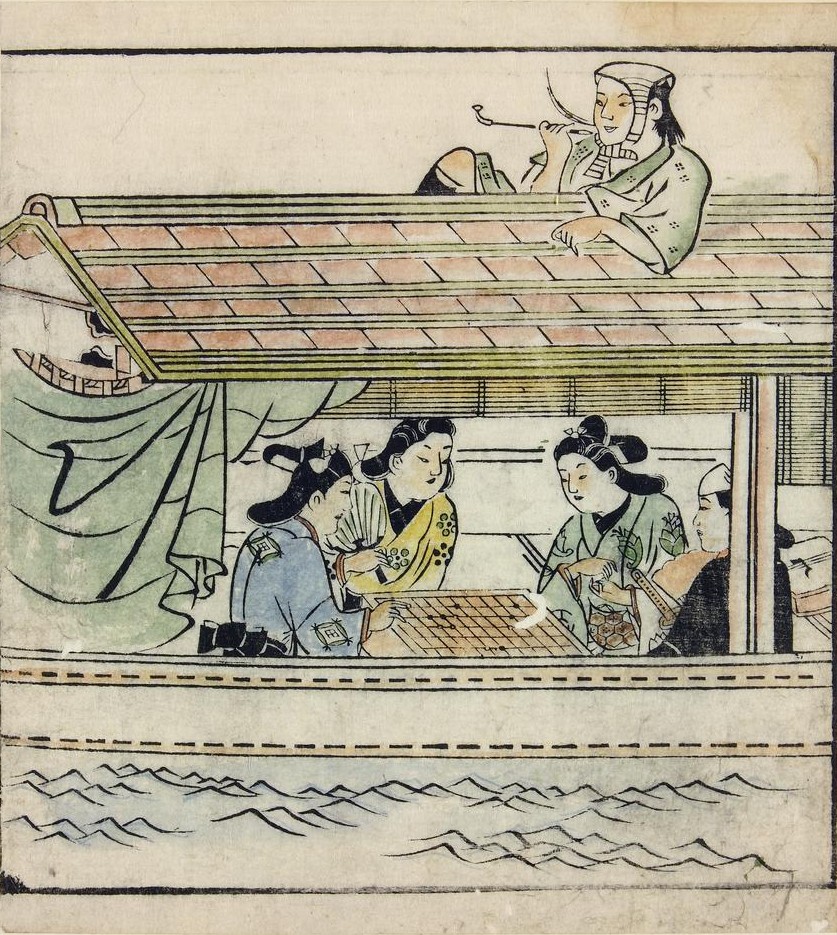
|
|
The collection grew in 2008 with prints from the acquired Miller Collection as shown here: 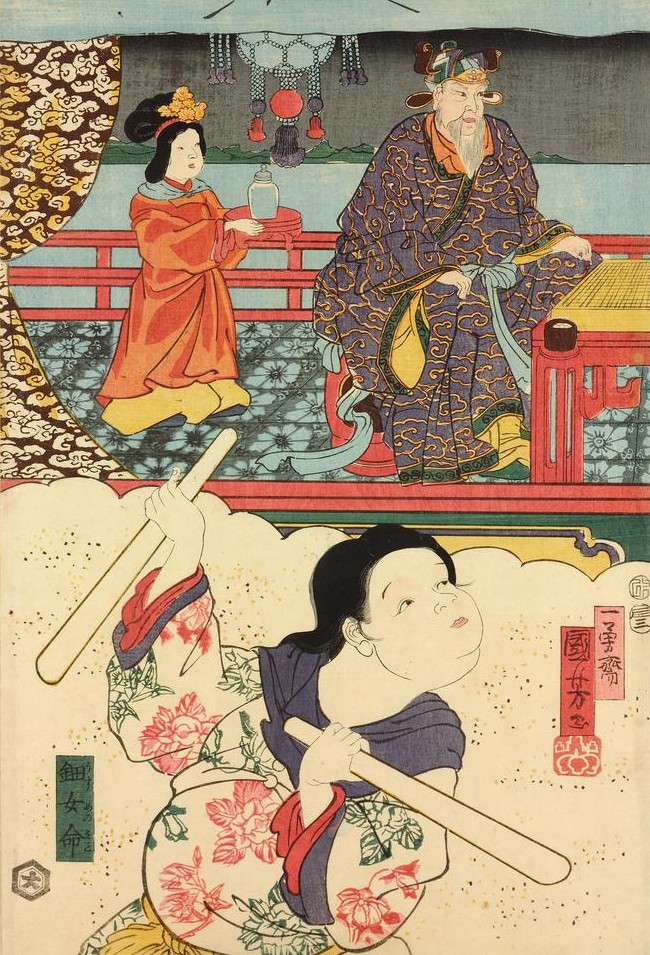
| |
|
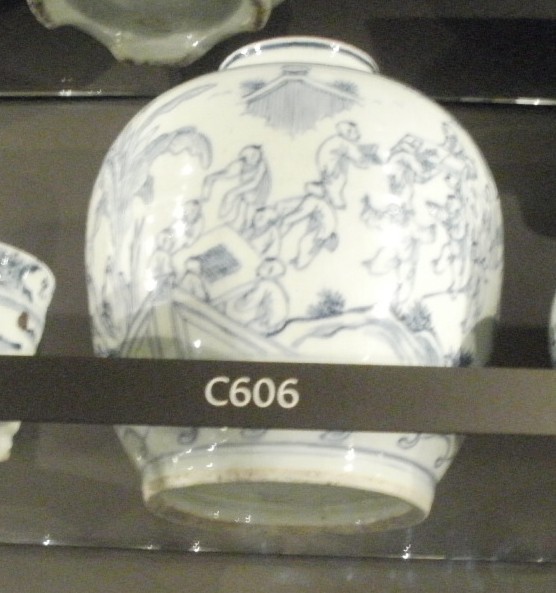
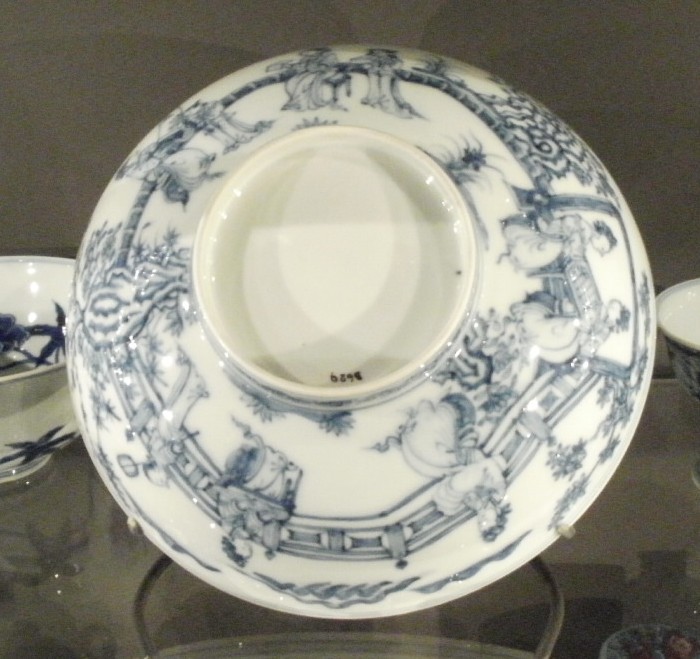
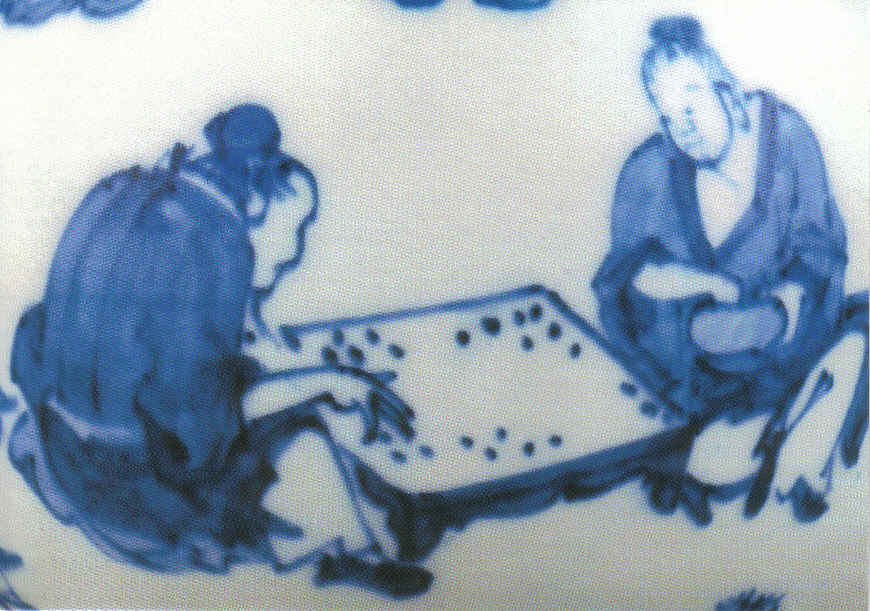
The Percival David Foundation of Chinese Art is a large collection of Chinese porcelain that was part of SOAS. It was on display in its own museum until it closed at the end of 2007. The collection has been transferred to the British Museum's Gallery 95. In the collection there is a Ming jar dated 1543 featuring Go players. The jar is 13.5 cm in diameter with blue underglaze decoration. Two players crouch at a board, one holding his bowl and the other playing a stone on the board which has no grid visible, but decorated sides and legs. Photo. The image featured on a greeting card. In case 23 item C606 is a larger 25 cm jar or vase featuring games, such as Bilnd Man's Bluff, but probably shows five people grouped around a Chinese Chess board, not Go. In case 21 item B629 is a 25 cm bowl featuring ladies in a garden under the rim. Two of them sit at a medium-sized Go board. | 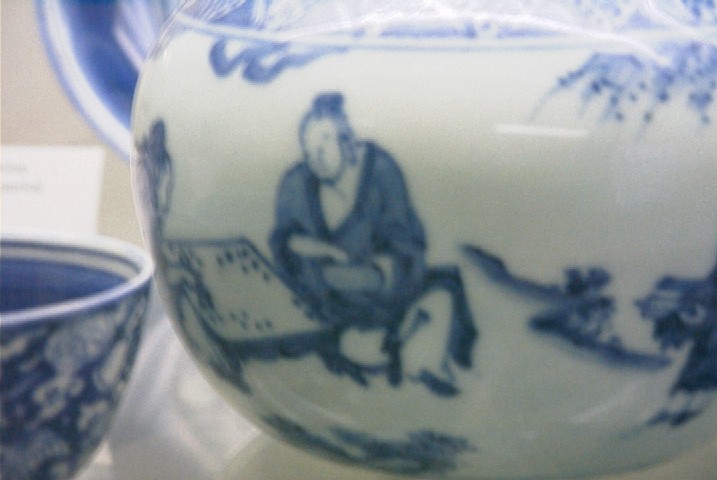
|
In the British Library collection from Dunhuang in China is a 6th century Go manual. It is sponsored by Peter and Sheila Wendes (Zenmachine).
Victoria and Albert Museum, London
|
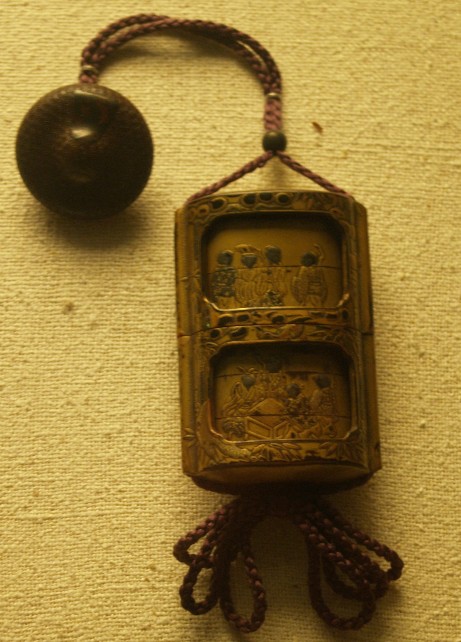
In the Japanese Gallery (45), there is an inro with cover from about 1700, made in lacquer with shell and foil. It is described as showing Chinese sages in scholarly pursuits; the lower front panel, of two on the inro itself, shows four men around a Go board. Vam catalogue entry |
|
|
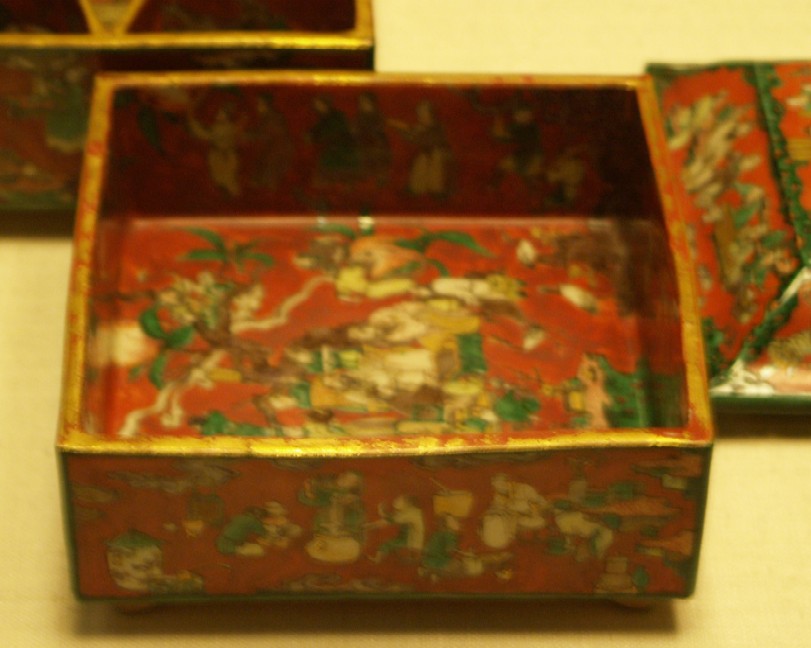
Also in the Japanese Gallery is a 15cm tiered food box made in porcelain with red overglazed enamel from Kyoto about 1800. It is decorated with figures and inside one has the Worthies at a Go ban. The artist is Aoki Mokubei. Vam catalogue entry |
|
|
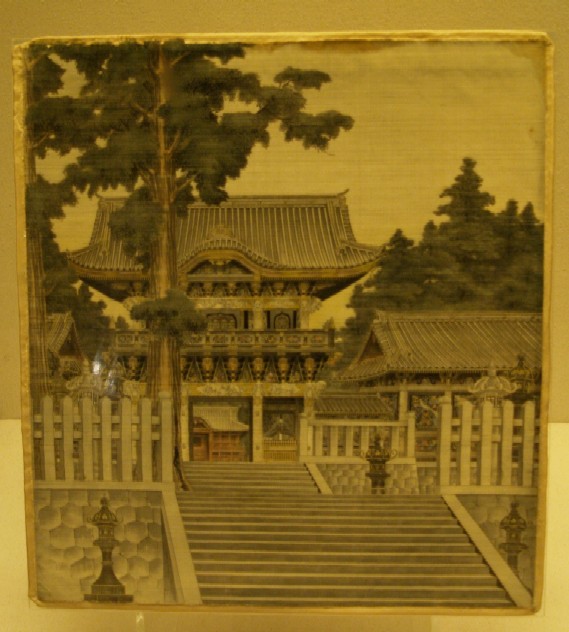
Another object connected to Go (not on display Autumn 2011) is a painted ribbed and cut velvet picture of the famous gateway Yomei-mon at Nikko, c1900. One of the carved panels on this gate is of a Go game, but there is not enough detail in the picture to see this. Vam catalogue entry |
|
|
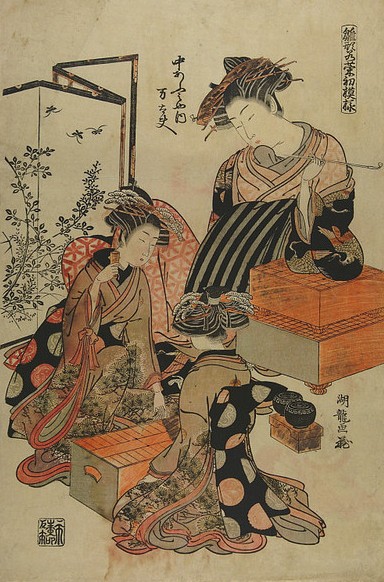
The museum owns a Japanese woodblock print (not on display Autumn 2011) of an interior with goban, called “Mandayu of the Nakaomiya House”. Two ladies play Sugoroku, the Japanese equivalent of Backgammon, whilst another smokes a pipe and leans on a pile of Shogi and Go boards. Vam catalogue entry |
|
|
In the Chinese collection in the Living section (not on display Autumn 2011) are 18th Century Go “boxes” (wooden Go bowls) and a thin modern board and stones, described as being “Encirclement Chess (weiqi)”. Vam catalogue entry | 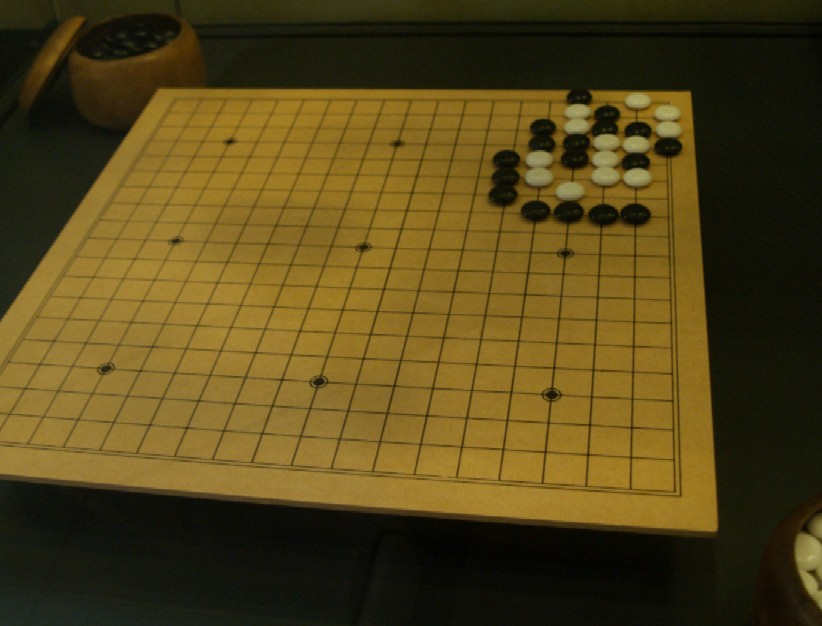
|
|
In the Chinese Gallery (44) in case 57 is an large (29 cm H 25 cm D) incense burner. It is porcelain with enamel decoration showing the Seven Worthies of the Bamboo Grove. As natural two are playing Go, with the others doing other worthwhile scholarly activities. It has been paired with a leaf-carved wooden lid and stand. Vam catalogue entry | 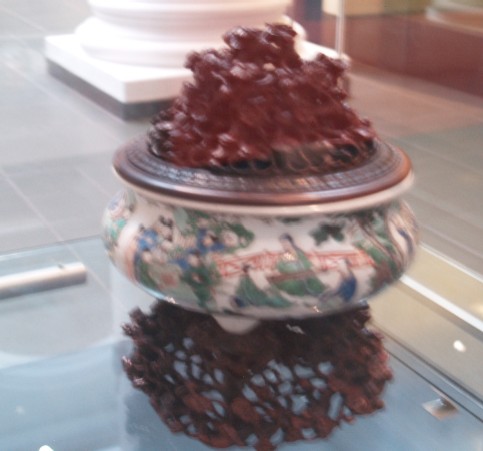
|
|
In the new porcelain galleries opened in 2009 (on level 6) there are many items depicting Go, mostly made in the 1662 to 1722 period in Jingdezhen, the centre of Chinese porcelain manufacture. More details on the porcelain galleries collection. |
Young V & A (formerly Museum of Childhood), Bethnal Green, London
|
Following museum refurbishment in 2006, their Go set (a thin folding board and shiny plastic stones) is now in a case of games in the top gallery. It is labelled: "Go 1977 - Probably the oldest board game in the world. It requires a very high level of skill". Unfortunately the stones were just in piles when viewed in early 2007. Previously the Go set and its cardboard box were in different cases in different galleries. They claimed the set was made by the Just Games Trading Co, but it is thought they just imported it. Vam catalogue entry | 
|
|
Also in the same case is a picture of a glazed tile, blue on white, made in 1881 by Maw and Co of Salop. It shows two toddlers playing “Go-bang” (Five-in-a-row), but they could just as easily be playing Go. Their mother leans over encouragingly. The actual tile used to be displayed, but has not been on display recently. Vam catalogue entry | 
|
Ashmolean Museum, Oxford
This museum was extensively rebuilt and fully reopened in November 2009. It has various objects in the East Asian Art collection.
|
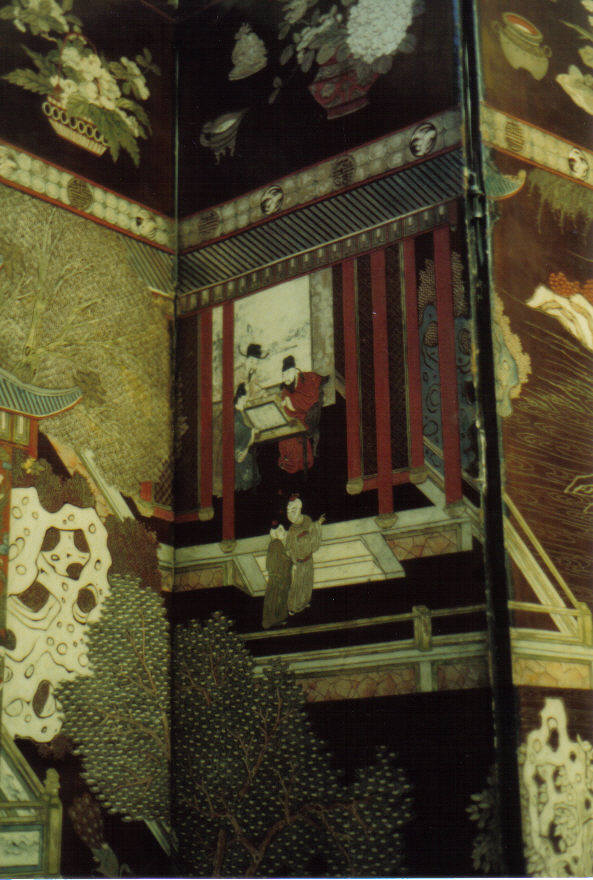
Coromandel Screen: a huge 12-panel 10 foot high wooden screen from Chinese Kangxi Period (1662–1722). It is gilded and coloured (painted and incised lacquer) with many scenes of dancing, soldiers, trees and buildings. On panel 9, in one building three old men are gathered round a Go board. The one in red points smugly at the board. Currently in Gallery 35 West Meets East. |
|
|
A black lacquered display case with decorated panels at the base. One is a Go scene with two Chinese men playing Go by some rocks and trees. A third man watches as the man in orange leans over to play the first move. Currently in Gallery 35 West Meets East. | 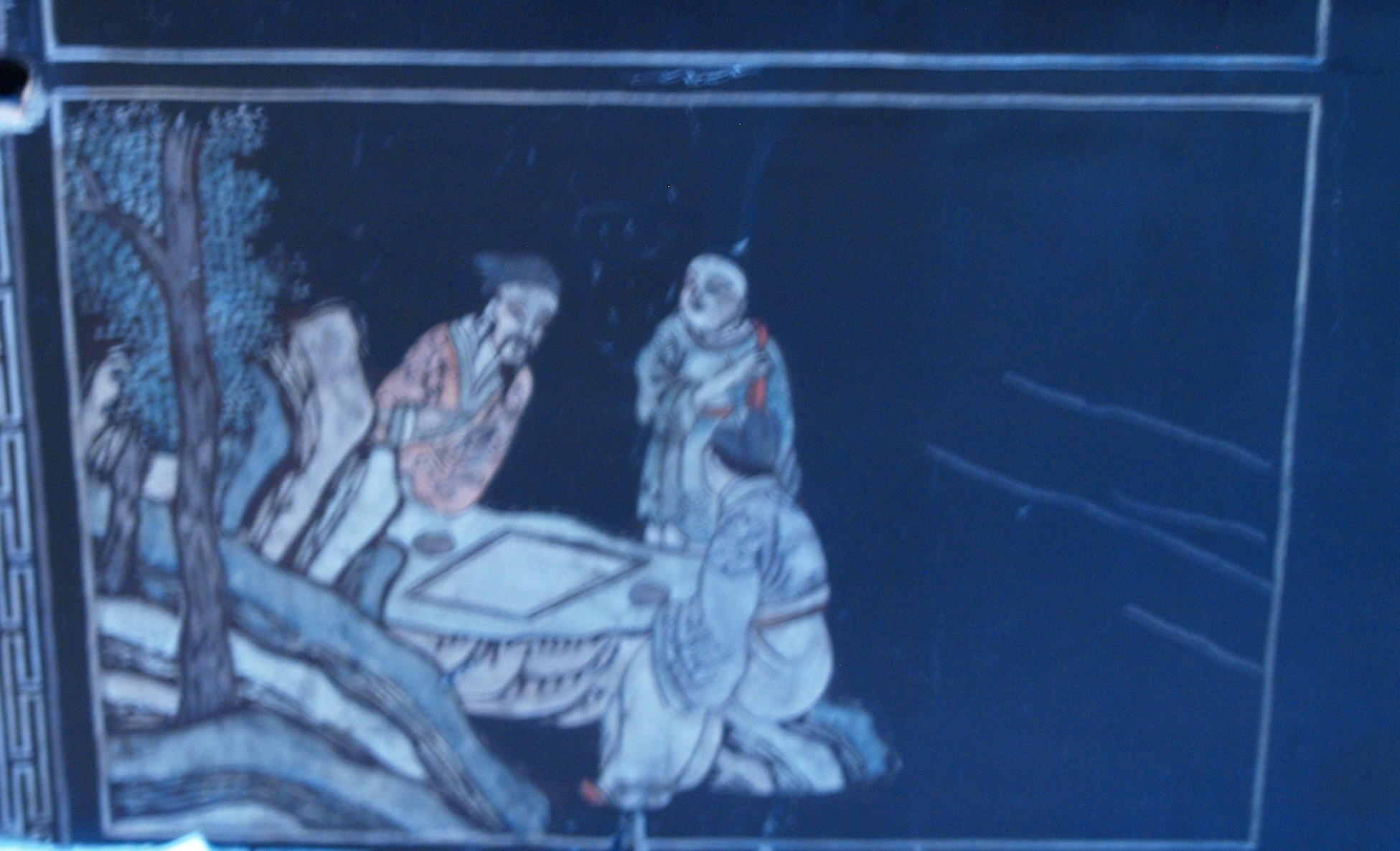
|
| Boy holding Dog sitting on a Shogi Board (or maybe a 10x10 Go board). From the late 17th Century, painted porcelain and similar to the boy on Go Board in the Fitzwilliam, Cambridge. He wears an orange leotard and the board has floral decoration on its white sides. Currently in Gallery 37 Japan 1600-1900. | 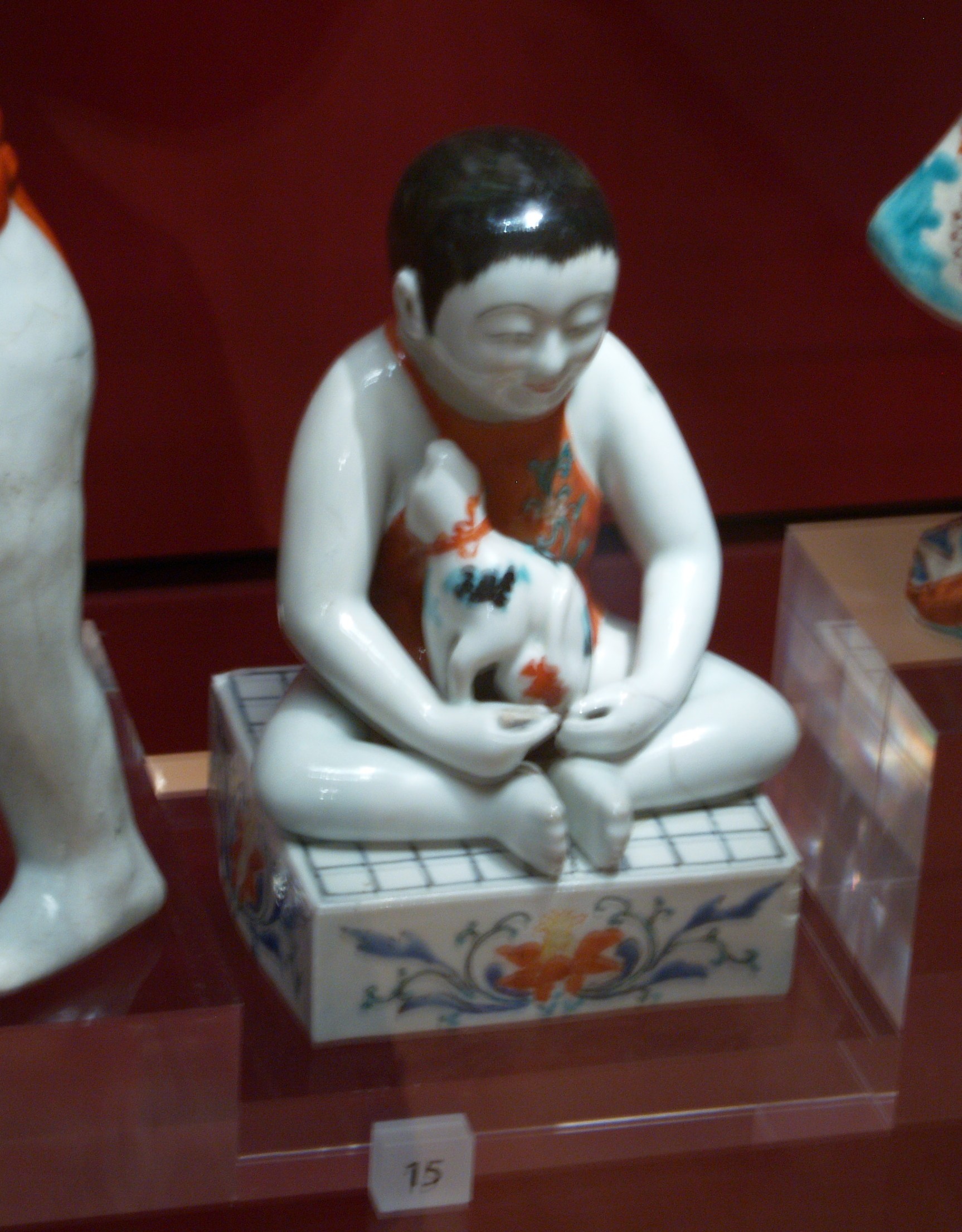
|
|
A Chinese plant holder in censer form with underglaze blue decoration, dated 1755 (Qianlong style). Shows a board on a fancy table with five large black stones placed as a handicap. Not on display. | |
|
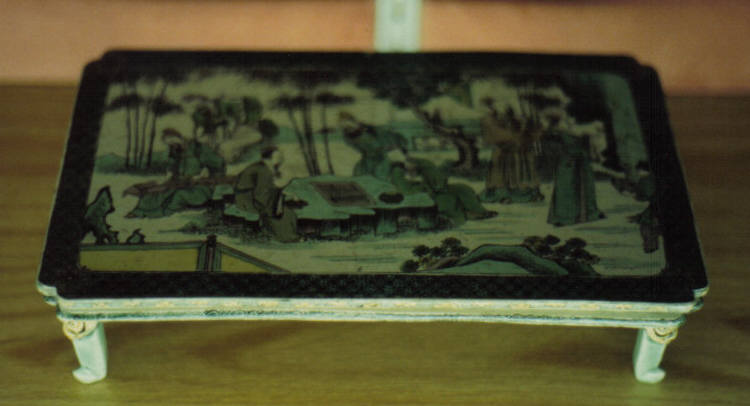
Porcelain Stand: Chinese Kangxi Period, famille verte colours on the biscuit. Shows the Seven Worthies of the Bamboo Grove at music, calligraphy and Go. Two men play whilst a third watches. Not on display. |
|
|
Large Dish: famille verte over glaze decoration. Shows ten ladies at pleasure: music, children and Go. The game is watched, seen through an open window. Not on display. | 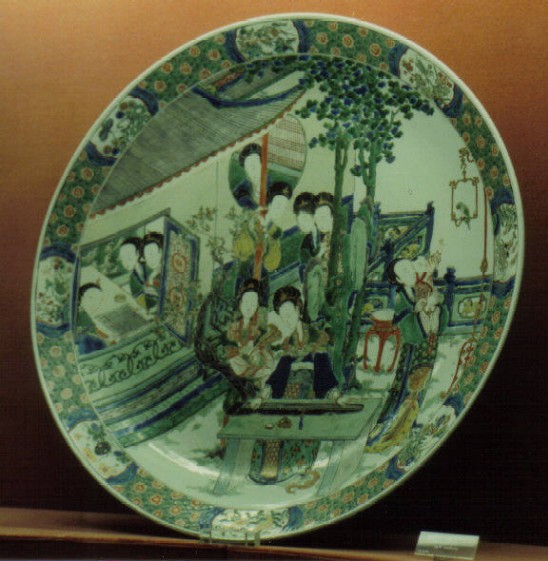
|
|
In Gallery 11 (Chinese painting): Drawing on ink on paper: attributed to Su Liupeng (1786-1862). Shows two men seated at a right angles, one on a boulder, with a paper board resting on a large boulder with tiny stones and low bowls. The caption does not mention Go, but one man is captioned a wood cutter. |
Pitt Rivers Museum, Oxford
|
Has several cases of ancient games (dice, cards, Warri, and so on) on the south side of the Lower Gallery, which also houses a collection of some thousand netsuke (Japanese belt toggles). In case L90A, a pair of Japanese black lacquer Go bowls with saucer-shaped lids, added to the collection in 1910 by a Dr Taylor. The white and black stones are displayed within and they are thin clam shell and slate, slightly smaller than normal; each stone has its catalogue number painted on. | 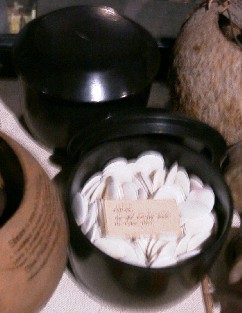 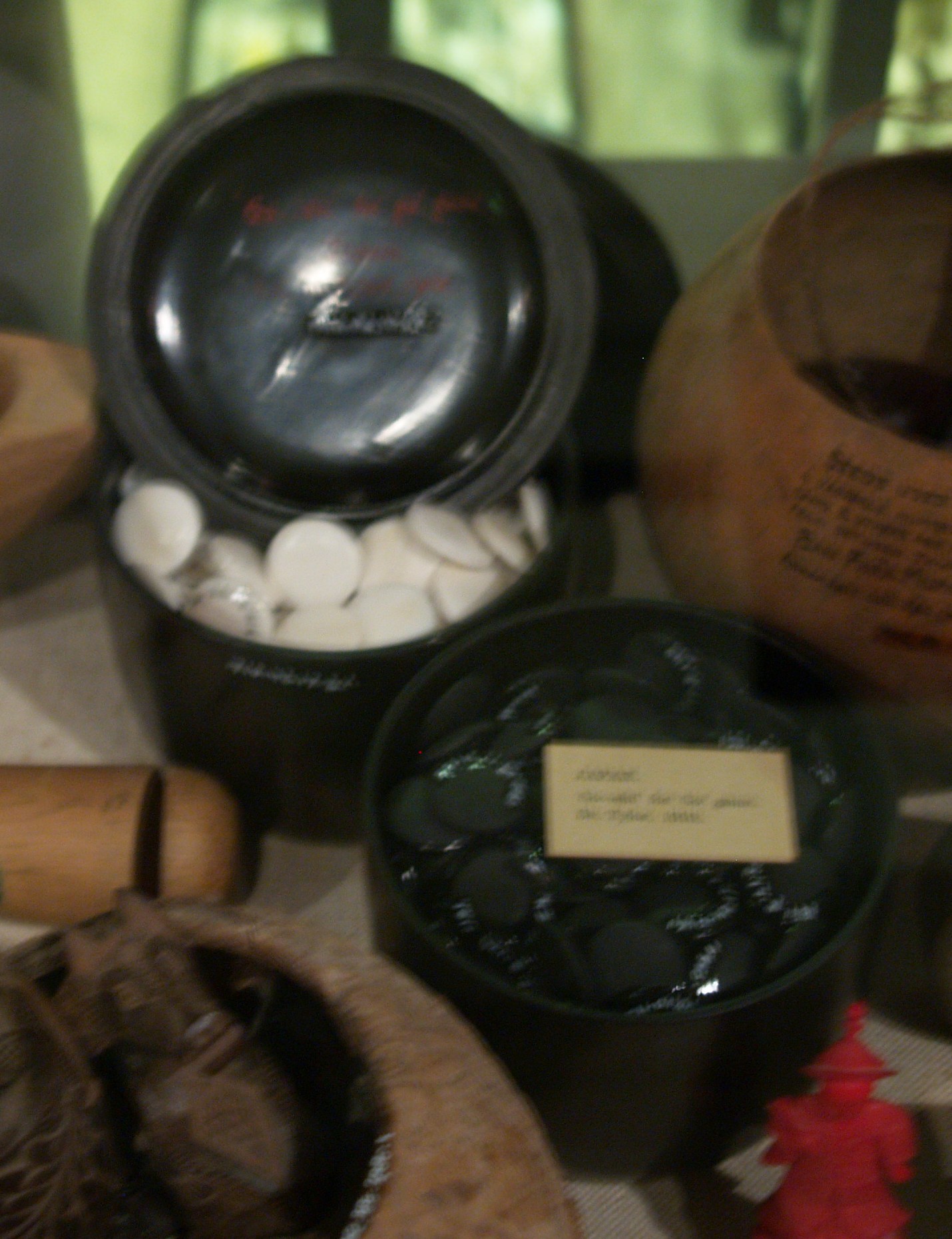
|
|
In case L89A, hand painted Hasami Shogi pieces collected in 1865. The game is described as Chess where you surround the enemy like simplified Go. There is also a set of normal Shogi pieces in case L90A. In case L95B, a netsuke of two men in a cave with a Go ban. | 
|
|
Sometimes in case L95C (but not on display May 2007), a netsuke of a monkey working a puppet on top of a Go ban. | 
|
Fitzwilliam Museum, Cambridge
|
In Room 26, item JL.9 is a moulded white porcelain ink stand of a boy sitting on a Go board, Japanese c1680. About 8 cm wide and 15 cm tall, a young boy in red leotard sits on a Go ban with feet together and knees akimbo. The board has flowers on the sides in enamel paint and blue grid lines (11x11) and typical Go ban feet. Also in room 2, item O.1938 is the left hand of a pair of painted glass mirrors, 60 cm by 90 cm, in gilt frames. It shows a couple seated at a table in open buildings by some water. They wear long coloured robes and hats in the Chinese style. The man rattles his stones in a brown bowl, while the lady holds a white stone correctly in her fingers. The grey board is depicted long and thin however. The mirror is mid-18th century. In room 28, item C10-1978 may show a representation of a Go board. A Ming double walled hot water bottle of c1500 shows on its inside surface five figures, two of whom are by a grid with blobs on. The perspective is wrong though and it could represent some sort of net in a frame. The bottle is 10cm in diameter and porcelain with blue painted underglaze. In the Sasakawa Fan Galley, a Chinese Brisé fan (hu shan) from about 1820-1840 has lacquered wood sticks. Part of the scene on one side shows two women seated on a bench and red chair playing Go on a red table. One holds out her hand to play a stone. Also in their collection are two Go netsuke; one is carved with Go players and the other is of a horse being ridden on to a Go ban. In addition they have two Japanese woodblock prints; one by Yashima Gakutei shows Go, from a series on the four accomplishments, and the other is Tadanobu defending himself with a Go ban. |
Maidstone Museum & Bentlif Art Gallery, Kent
|
Photos copyright of and reproduced by permission of Maidstone Museum This museum has the Walter Samuel Collection of Japanese art and also Julius Brenchley's Cabinet of Curiosities, both of which feature Go-related items. In 2012 a new extension was added to the building with the Japanese Gallery now above the new main entrance. The items on display have changed and some of the items listed below are no longer on display. | |
|
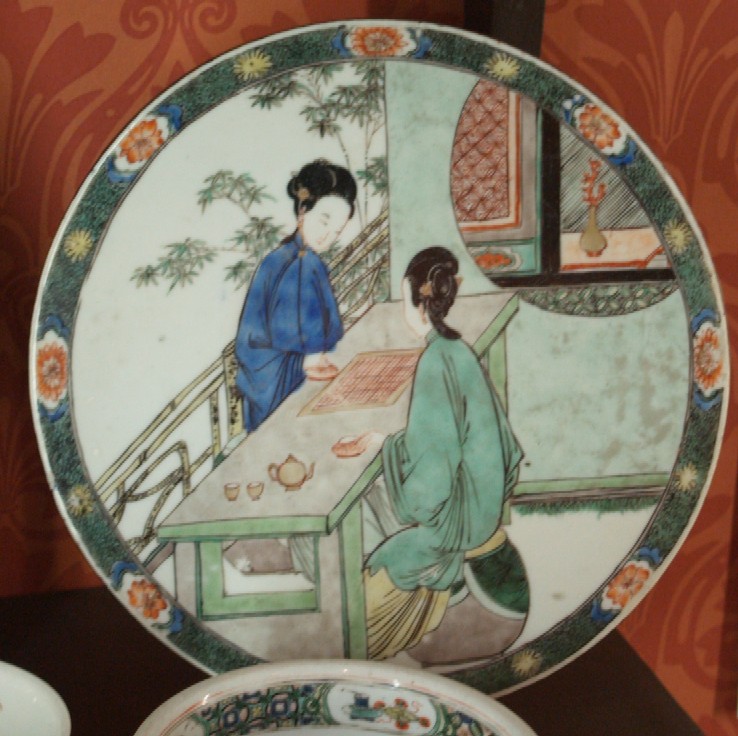
In the Cabinet of Curiosities in the Brenchley Room is a Chinese porcelain famille verte plate from 1720 showing ladies taking tea on a verandah about to play a game. |
|
|
In the new Japanese Gallery there is on display, in a case beneath a cabinet, a complete service of bowls, plates and beakers. The design features two men in old costumes kneeling at a goban, with a lady behind to the right and a potted tree to the left. |
 |
|
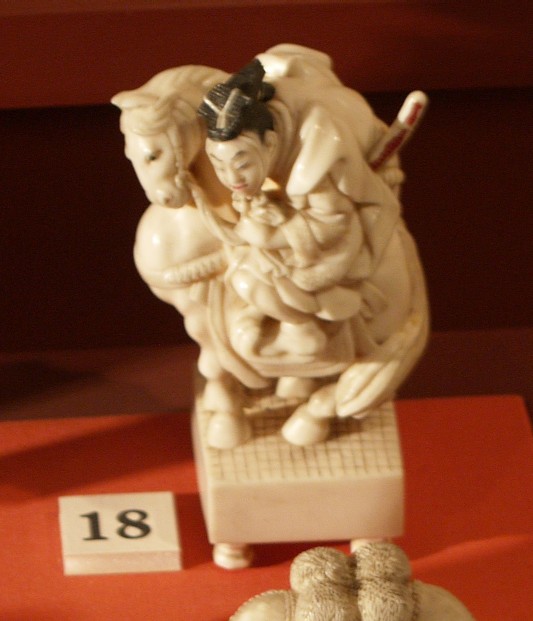
Previously in the former Japanese Gallery in the People, Legends and Gods case, item 18 was an 8cm tall 19th century ivory figurine of a man, Oguri Hangan, riding the tamed man-eating horse “onikage” balanced on a goban, by Hakuunsai. |
 |
|
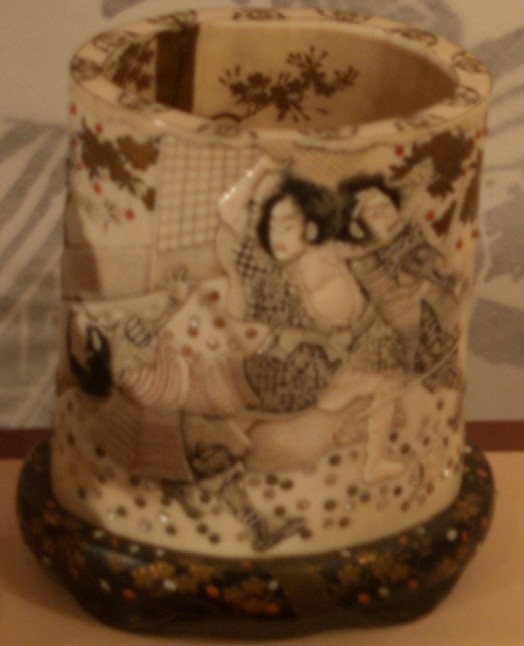
Also there was a large, 20 cm tall, oval pot (maybe a brush holder) of elephant ivory on a decorated wood base from 1860s. It shows a samurai fighting assailants, hitting one with a goban held over his head, the coloured Go stones spilling everywhere and the bowls kicked over. |
|
|
There was an unglazed ceramic enameled tea-pot, 8cm big with side handle and spout, by Kentei c1800. A large group of kids practise calligraphy and play Go; one is pointing at a move on the board. |

|
|
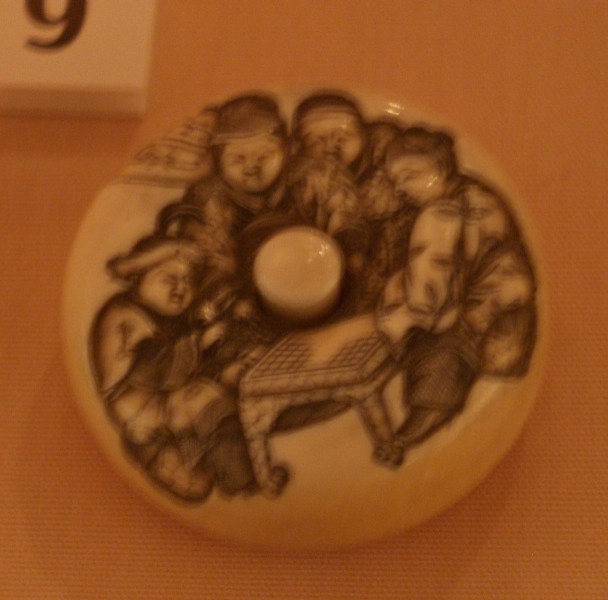
Previously on display in their collection of inro and netsuke was a 3 cm white donut-shaped netsuke, with stopper showing with four people and a goban on thin legs. |
|
|
In their travelling exhibition of Japanese woodblock prints, an 18th century print by Isoda Koryusai described as "Courtesan with two kamuro". It is of two women playing Sugeroku (Backgammon), with a third leaning on a Shogi and Go ban. A copy can be bought via their web site. | 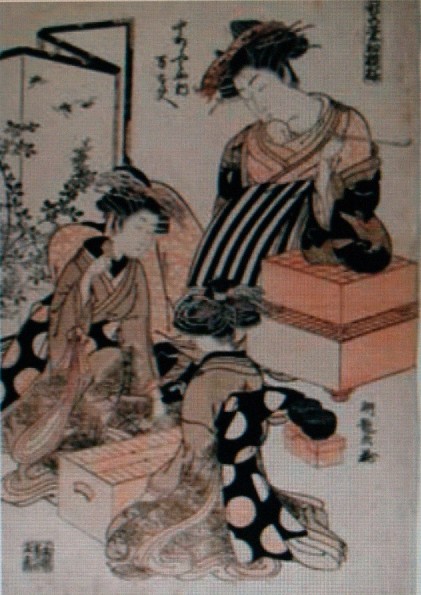
|
Russell-Cotes Art Gallery and Museum, Bournemouth
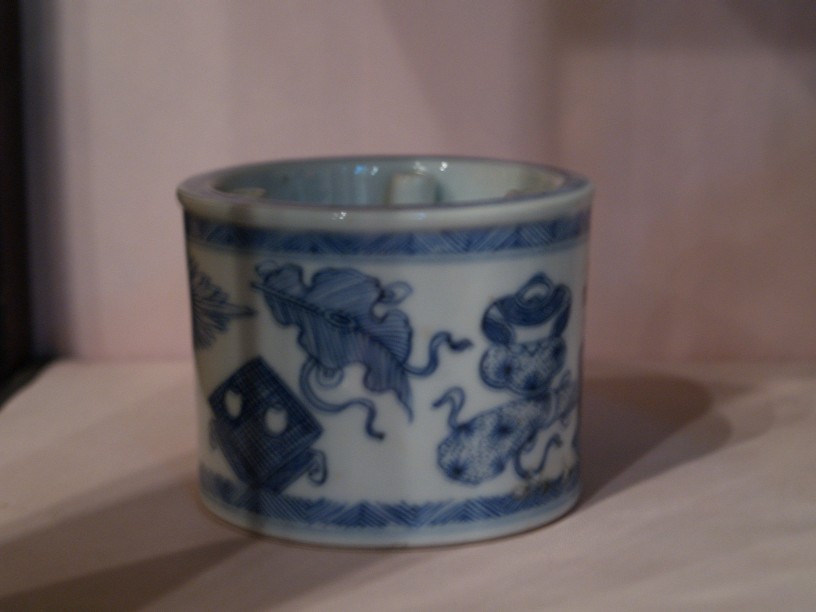
| Has a large collection of Japanese artefacts, but it is a Chinese porcelain ink stand that features Go. It is white with blue decoration and about 8 cm in diameter. It shows a Go ban with curly feet and a pair of bowls sitting on it. It is in a small three-shelf cupboard in the Study. |
|
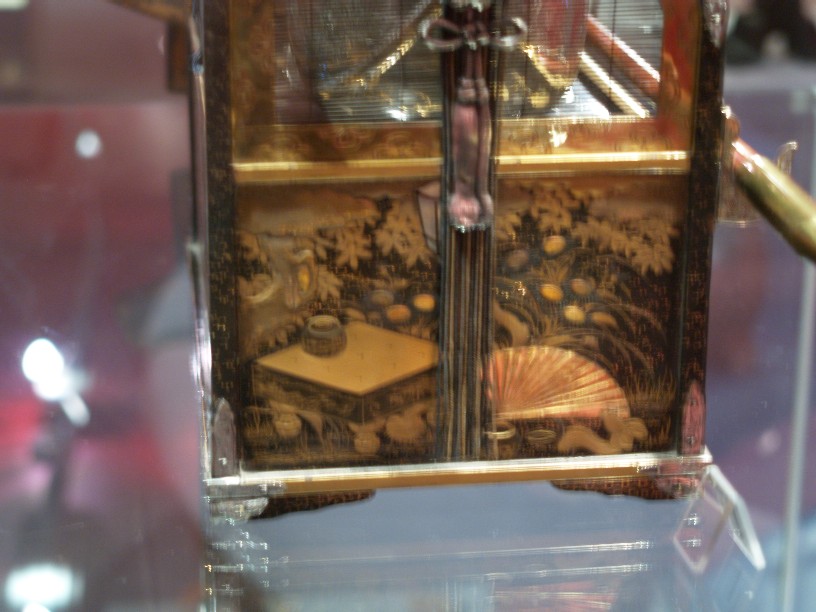
| Also in the Japanese beaten metal display, item 1 is a 19th century smoking cabinet in silver, gold and lacquer. On the left end it has a Goban in a garden with decorated sides and ornate bowls - one is on the ban and the black one is open on the ground to right beneath a golden fan. |
|
The Wilson, Cheltenham
| Has a 12-panel coromandel screen from China, Kangxi Period (1662–1722). It shows a wedding scene and includes a roundel showing three people gathered around a Go board. It was hangings on the end wall of the oriental gallery, prior to museum refurbishment. |

|
Museum of East Asian Art, Bath
|
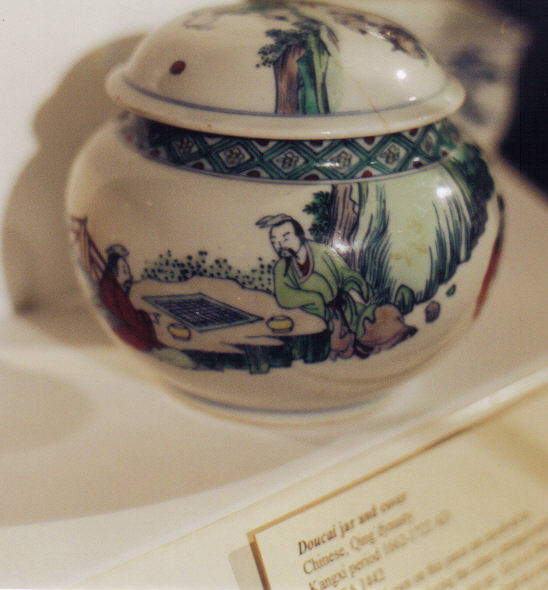
Has a small Doucai jar and cover from China, Kangxi Period (1662–1722). It shows two men playing Go on a large tree stump. |
|
Bristol City Museum and Art Gallery
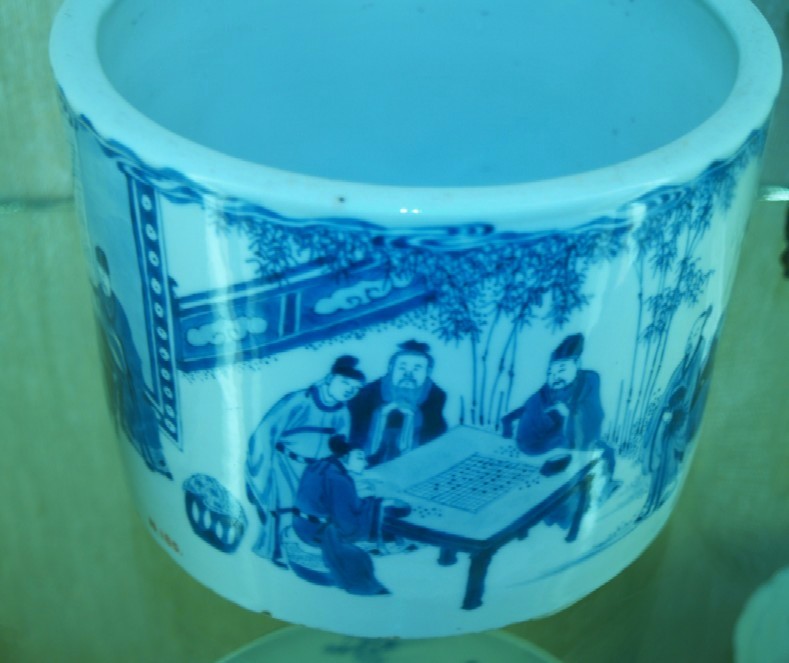
| Has an Chinese 18th Century brush holder, 15cm diameter with blue underglaze. A man and woman sit playing at a large table. They have bowls and stones are scattered both around the board and on. Two men stand watching from the side and a fifth person stands nearby. It is item N185 in case Oa in the oriental gallery on the top floor. |
|
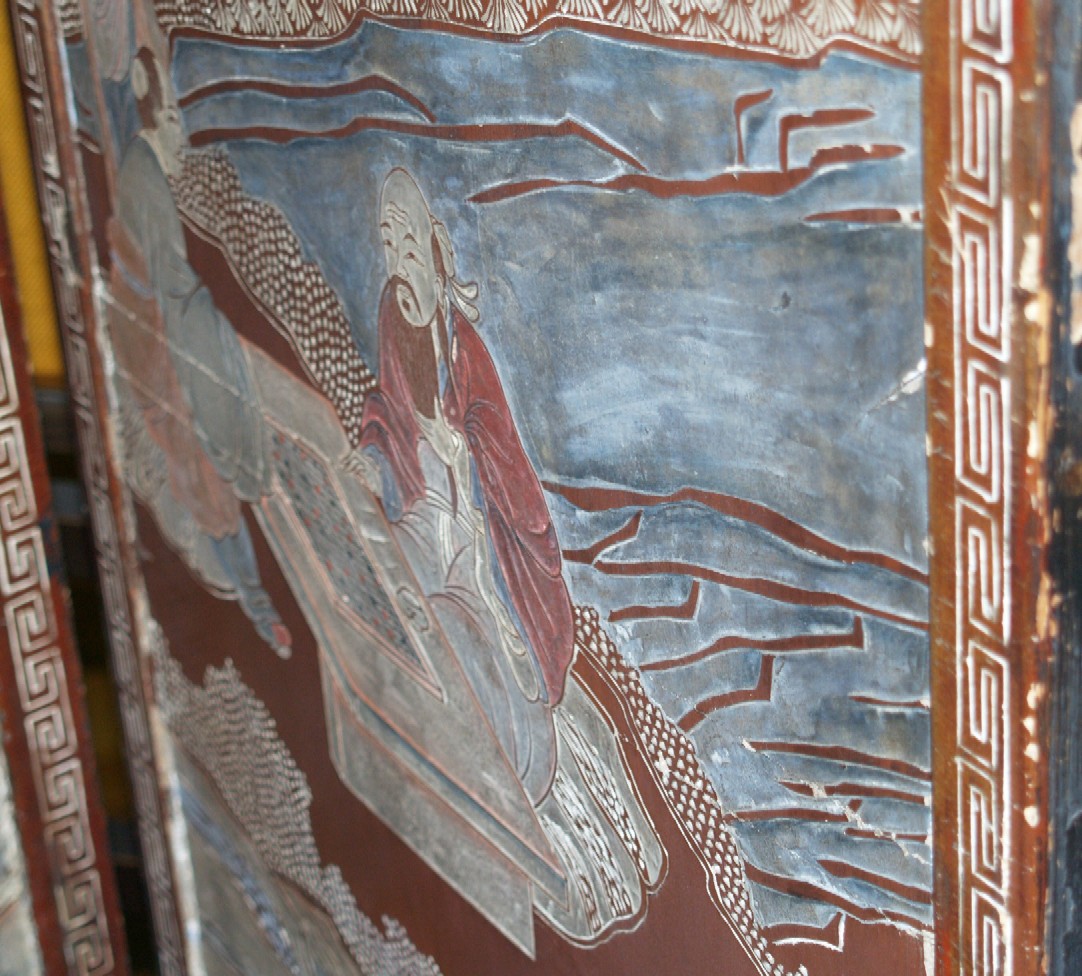
| Also in the oriental gallery is a large 18th Century coromandel screen, lacquer on wood. On the rear of one end panel is a Go scene. Two men sit at a stone table and play with black and red stones; one has a bowl. Two men watch from one side whilst a fifth man stands holding a pike on the other side. |
|
The Box, Plymouth
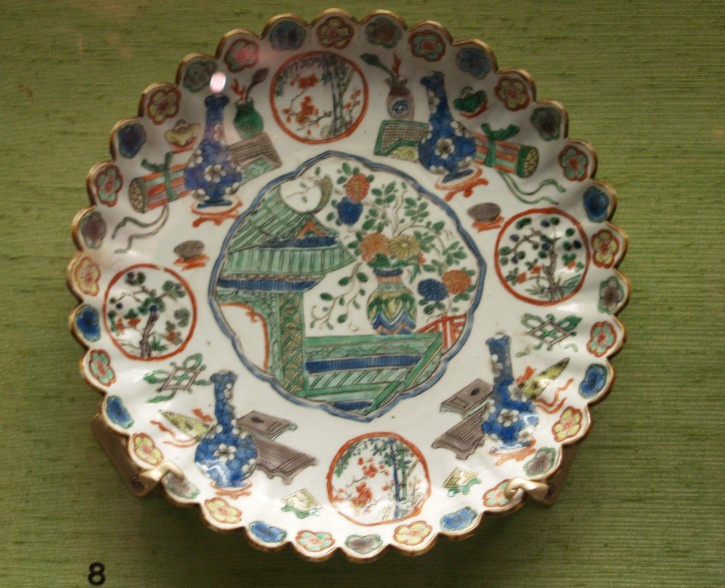
| Prior to rebuilding as The Box, the museum had, in the China Connection gallery on the first floor, a Chinese porcelain plate from between 1622 and 1722. It has flowers around a lobed edge, part of a building in a central frame, and a ring of various cultural objects such as vases, quivers, musical instruments and what appears to be folding Go boards. It is multicoloured on a white background. |
|
| Also there is a blue and white Chinese porcelain jar, about 20cm diameter, from 1662-1722. There is a photograph of its reverse design which shows a "Chess board" on a table with spindly legs. This probably represents Go as there is no river visible and the vase depicts Buddhist cultural emblems, such as music and calligraphy. |
Royal Cornwall Museum, Truro
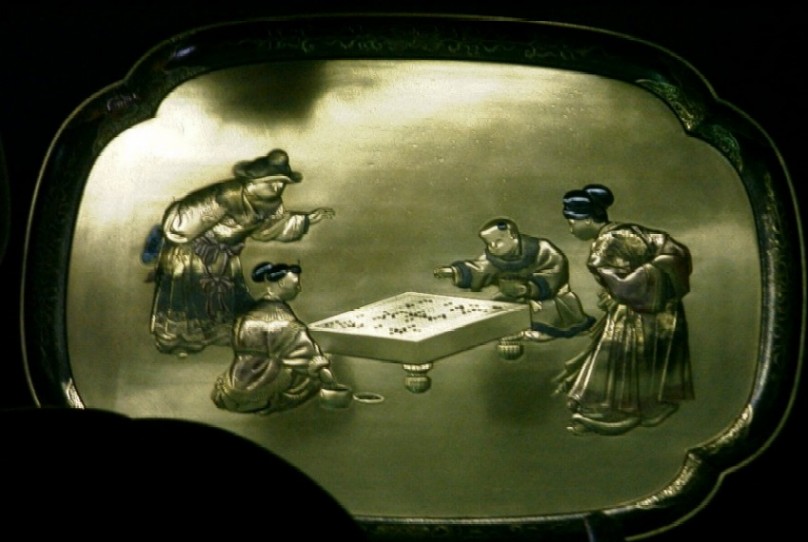
| Has an indented-oval gilded box (size 15×10 cm) with lid and inside tray, probably by Hayashi of Tokyo. On its inside tray a monk and a lady are seated playing Go. With one arm the monk clutches his bowl and with the other he stretches out to play a white stone. Another couple stand watching either side. Their costumes are delicately coloured. It is in a case on the balcony. |
|
Lady Lever Art Gallery, Port Sunlight, Merseyside
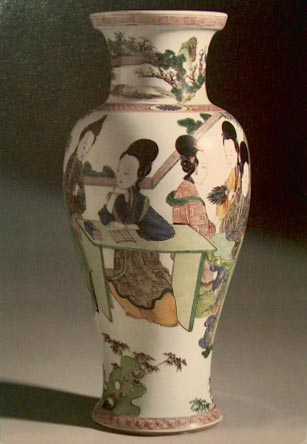
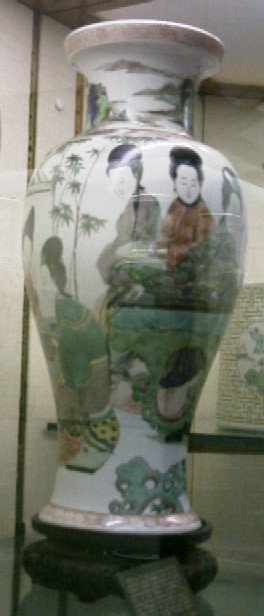
| In Room 8, there is a pair of Chinese porcelain vases decorated with women performing the four elegant accomplishments: painting, literature, music and checkers - which is of course actually Go. It is from the K'ang-Hsi period (1662–1722), just under 18 inches high and famille verte enamels. In the photos of the vases, one can just see on the side of that on the right one of two ladies sitting at a green table with a board, bowls and black stones, including captives, visible. |
|
Hollytrees Museum, Colchester
| There is a golden and painted Chinese fan presented by the local Chinese Society. It is not fully unfolded, but appears to show a man standing in front of a Go board amongst the pictures of figures. |
Oriental Museum, Durham
Photos copyright of Durham University Museums
|
In the Games case on the ground (top) floor is a brightly decorated Chinese porcelain plate. It is about 5 inches diameter and shows ladies playing Go. Two sit at a table on a veranda and play, while two more stand and watch. The caption explains the ladies are "playing Wei Qi (also known as Go)" and states "It is considered by many games experts to (be) the most complex strategy game in the world, far more complex than Chess." |

|
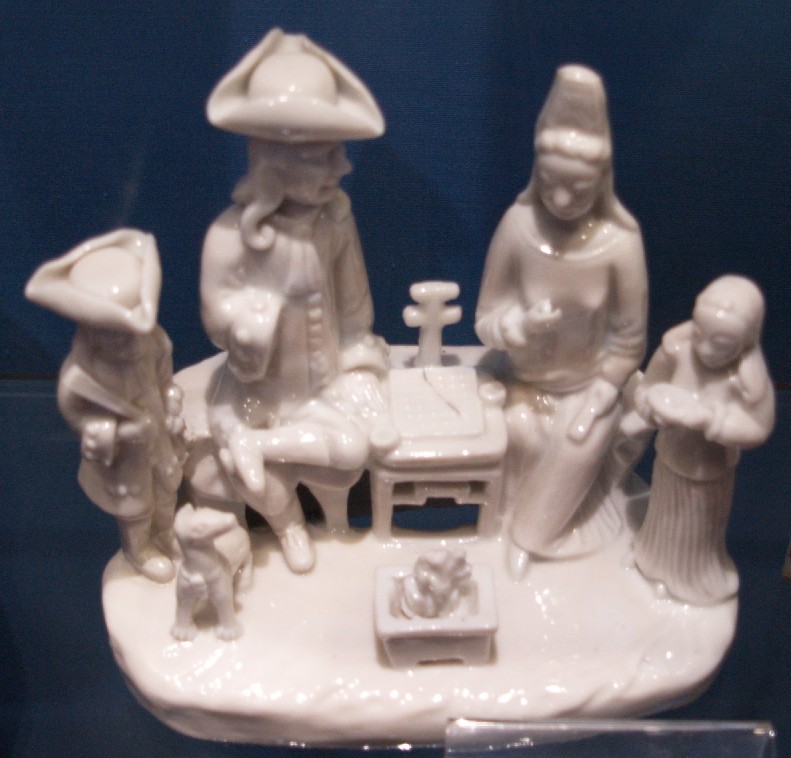
| In the Chinese Trade case on the ground (top) floor is a Chinese white porcelain figurine. It was made in the mid-19th century and unusally shows a western family indulging in oriental culture. It is supposed to be Governer Duff, in a tricorn hat, and his wife, two children and a dog. The adults sit with a small board (8x8) and go bowls on a small table between them. The grid is marked with ridges, but there is unfortunately a crack in the glaze across the board. |
|
National Museum of Scotland, Edinburgh
|
In the new (2019) Exploring East Asia Gallery there is a case containing the implements needed for a scholar to be equipped for the arts. Included is a Go set from China with wooden bowls, table board and Chinese-style stones, dated 2015. The caption is "Board game of strategy (weiqi): A game for two players, the art of playing weiqi is sophisticated but has simple rules. The aim is to surround more territory than one's opponent." As of 2024, the video being shown on Asian culture includes scenes of Baduk players in the South Korea section. Also in a nearby case is a netsuke of three monkeys around a gaming board, though the stones are in the squares not on the grid. |
  
|
Museum of Farnham
|
On the shelf over the fire place in the Georgian panelled room are some oriental jars, one of which (about 20cm tall) depicts a box, a flower vase and a Go board with bowls thereon. |

|
Newarke Houses, Leicester
|
In the toy and games gallery there is a Go set. The stones in card boxes with Korean labelling are about 1cm diameter and the orange folding board is about 45cm long. However the board has the reverse Korean Chess board visible because of the way the hinge is. The caption says: "Go Board and Counters. Go originated in China about 4000 years ago. This board came from South Korea in 1960." In the lift the flap toys and games quiz next to the case one question is "Although I am the oldest game on display here children still play with me today." When the flap is lifted it shows the board Go side up with a ko shape in stones. |

|
Stately Homes
Chiddingstone Castle, Kent
|
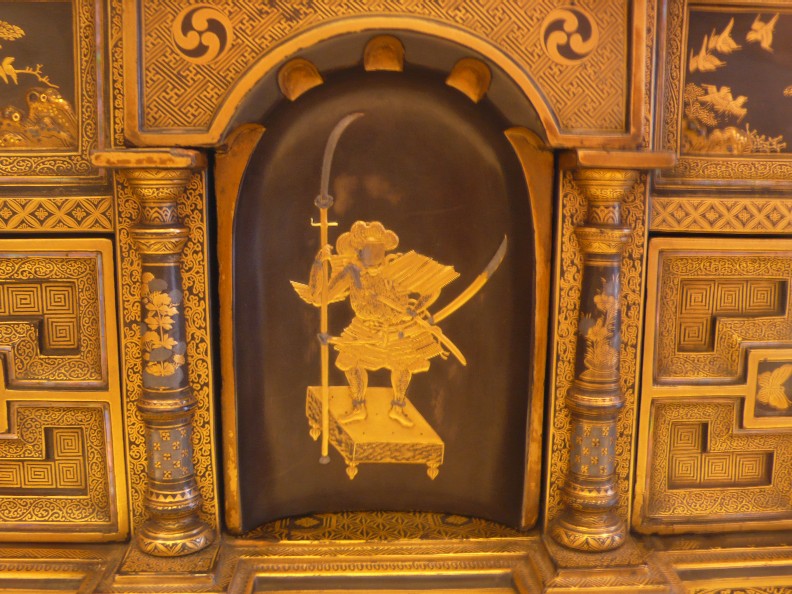
Contains the collections of Denys Bower. The star of the Japanese collection is the Beckford Casket, 1635-1640. It is about 40 cm square, and the same high, and is decorated with lacquer and gilt. The arched panel on the front contains a relief of a samurai, with a stave (noginata) and two swords, standing on a decorated goban. The goban has decorated faces and legs, and has the handicap dots visible. |
|
Clandon Park, Surrey
|
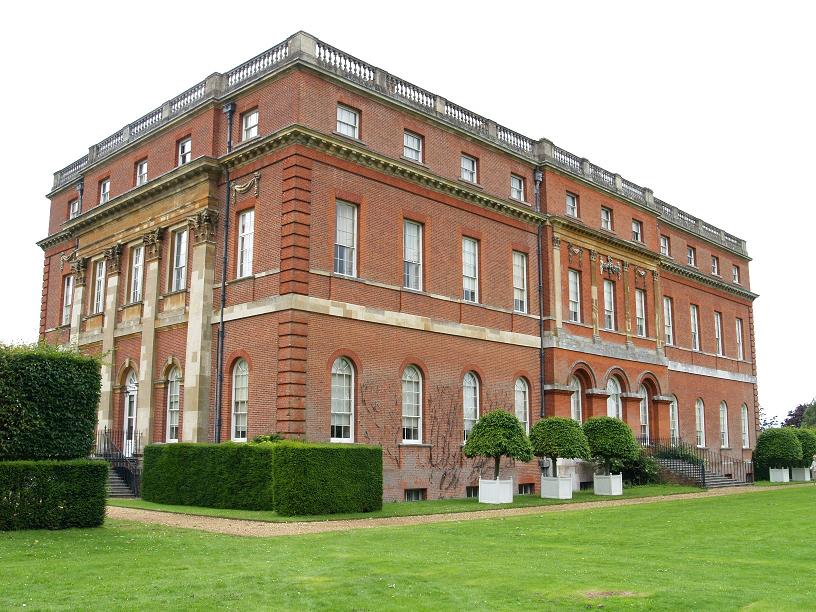
In the Hunting Room on the ground floor was a 17th century Chinese coromandel cabinet. It has brass hinges and handles and rests on a large metal stand. It is decorated with figures, including children at play and various adults at pursuits such as music and caligraphy. On the right hand door, two women are playing Go, whilst a third stands and watches. They play on a white board, resting on a wooden table on a veranda. One has a fan and they have elegantly decorated costumes. It is not known if it survived the devastating fire of 29th April 2015. |
|
The Vyne, Sherborne St John, Hampshire
|
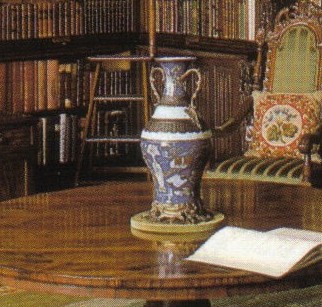
This house dating from the 16th Century has two porcelain objects featuring Go. In 2007, on the circular table in the library is a large 19th Century Chinese vase. It has ormolu handles and base, is about 70 cm tall and has a background of cobalt blue. It is decorated with fish, vases and other objects, including a flat gray Go board with two brown bowls. On the mantelpiece in the gallery bedroom is a small rectangular Chinese porcelain dish and lid, about 10 by 7 cm. On the lid, two ladies sit at a red table and play on a flat grey Go board, with one brown bowl visible. Other people stand nearby. |
 |
Mompesson House, Salisbury
|
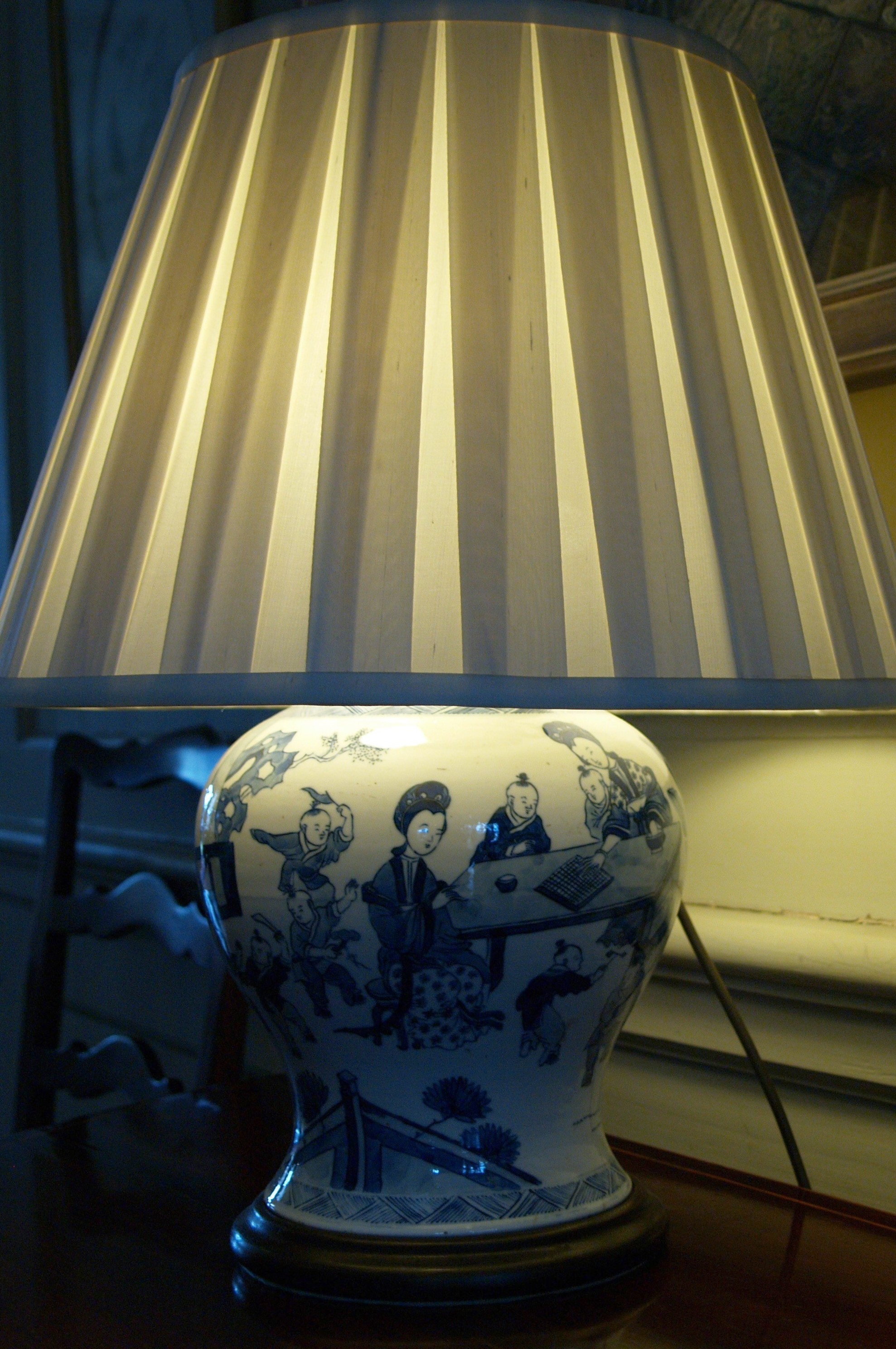
This house is delightfully situated in the Salisbury Cathedral Close. On a table in the passage to the rear of the entrance hall is a 19th Century Chinese vase in use as a table lamp. It is 10 inches tall with blue on white glaze. Two women play Go with the board on a long table. One sits on a stool and the other stands with her right hand playing a stone and her left hand in her bowl. Four children are at play by the table. |
 |
Osborne House, Isle Of Wight
|
Believed to have a vase depicting Go in Japan. This was hard to see in 2005, assumed to be the large vase on the floor on the far side of the dimly lit side room to the council chamber. |
Corsham Court, Wiltshire
|
This house, famous for its art collection, also has a lot of Chinese porcelain. One of the large blue-on-white floor vases in the Picture Gallery has a Go board, with two blobs for bowls and a faint scattering of black stones, on its lid. |
Abbotsford, Melrose
|
Abbotsford, near Tweedbank in the south of Scotland, is the early 19th Century home of Sir Walter Scott. There is a very significant item which virtually proves that Scott knew about Go. The Chinese Drawing Room is decorated with hand-painted Chinese wallpaper, a gift from his cousin Hugh Scott of the British East India Company. The design is trees full of birds, on a bluish-green background, with scenes of Chinese people engaged in various pursuits at the bottom. To the left of the door to the library, there is a game of Go prominently featured. There are two seated players at a table with a large white flat board on it. Their Go bowls are clearly visible and they have tea cups. The old man on a pink stool in front points with his finger. A third man is watching from the left and a fourth head peers around a tree to the right. The board looks too big but actually does have 19 lines each way. The handicap points are marked with four L-shapes, but are the five-five points; there are lots of moves played but it does not appear to be a real game position. |
 |
Exhibitions
Game Plan: Board Games Rediscovered
The Young V & A (formerly Museum of Childhood), Bethnal Green, London, put on an exhibition on the history of board games between 8th October 2016 and 23rd April 2017 called "Game Plan: Board Games Rediscovered". It of course featured Go.
Ming 50 Years That Changed China
From 18th September 2014 to 5th January 2015, an exhibition was held at the British Museum. It was called "Ming 50 Years That Changed China" and consisted of exhibits from the British Museum and items on loan from ten museums in China and elsewhere. All items date from the Ming dynasty years 1400 to 1450, a time of peace when the capital moved to Beijing. Some of the items displayed featured Go.
China: The Three Emperors
From 12th November 2005 to 17th April 2006, an exhibition was held at the Royal Academy of Arts. It was called China: The Three Emperors 1662-1795 and consisted of exhibits from the Palace Museum, Beijing. Several of the items displayed featured Go scenes.
Across the Board
Various objects from the British Museum's games collection toured the UK in 2005-2007 as the Across the Board exhibition. It visited Segedunum Fort, Exeter, Gosport, Leicester, Lincoln and Luton.
Others
The Queen's Collection
The Queen's Collection is known to feature Go-related prints and she was presented privately with a set of yunzi stones in China a while ago (kept at Sandringham).
Wellcome Trust
|
In their Asian medical collection is a woodblock print by Kuniyoshi, 1853, showing Chinese surgeon Hua T'o operating the arm of wounded war hero Guan Yu, who plays Go to distract from the pain. This was used as the cover picture of Go World magazine issues 7 and 83. This and some of the collection was on display at the Brunei Gallery, SOAS, London from 13th October to 12th December 2004 under the theme Body, Mind and Spirit. | 
|
Related Collections in Museums
Varous other museums have large oriental collections, for example, the Horniman Museum in Dulwich, London SE23 3PQ, has a lot of Japanese items in its ethnic collection, but nothing Go-related is normally on view.
Various toy museums around the country display old games, such as at Pollock's Toy Museum in London and the Edinburgh Museum of Childhood, but Go is not normally featured.
If you have any comments, please email the webmaster on web-master AT britgo DOT org.