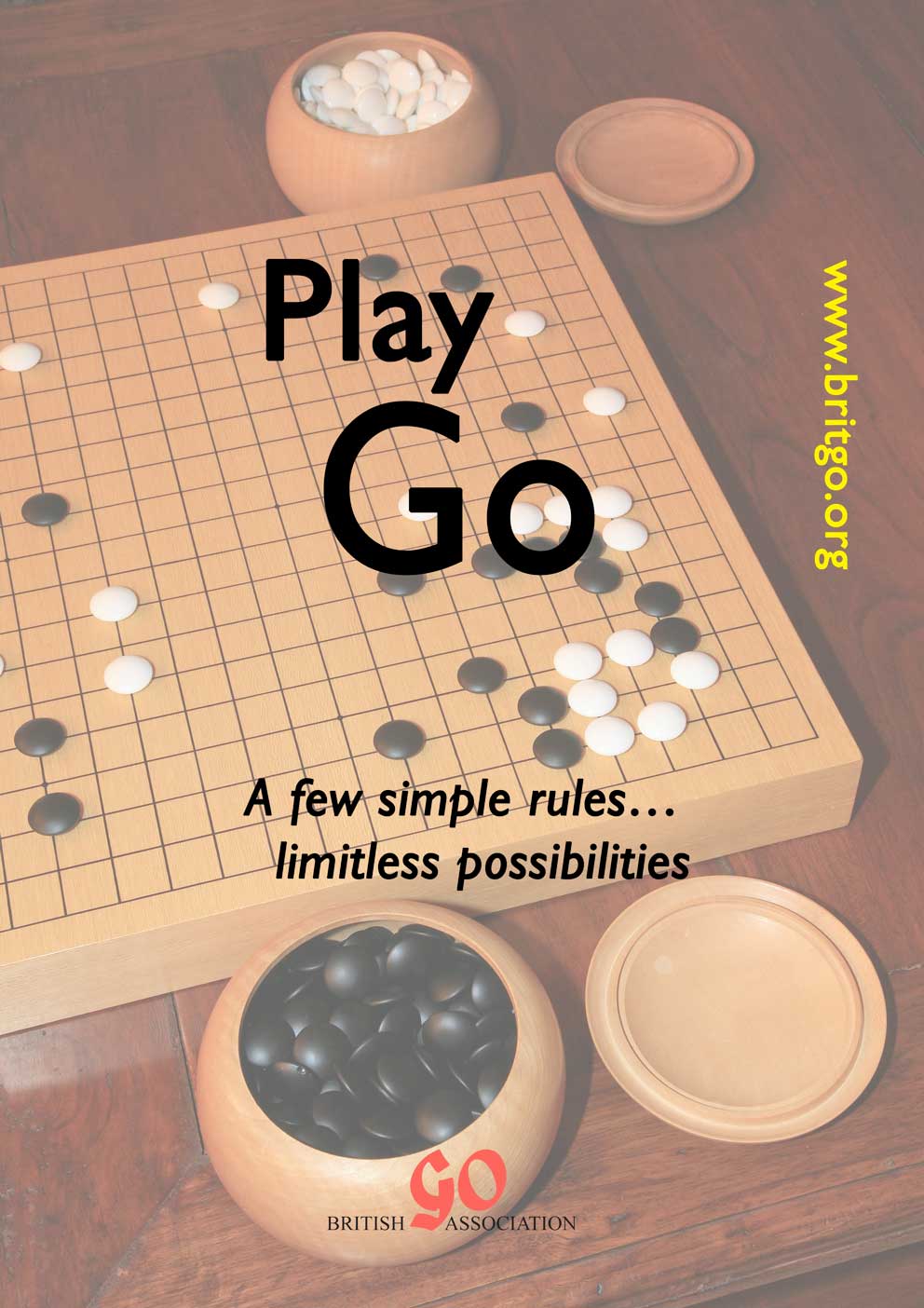
Introduction to the game of Go

Go is unique among games

The history of Go stretches back some 3000 years and the rules have remained essentially unchanged throughout this very long period. The game probably originated in China and the future of Tibet was once decided over a Go board when the Buddhist ruler refused to go into battle; instead he challenged the aggressor to a game of Go.

In the Far East, where it originated, Go enjoys great popularity today, and interest in the game is growing steadily in Europe and America. Like Chess, Go is a game of skill - it has been described as being like four Chess games going on together on the same board - but it differs from Chess in many ways. The rules of Go are very simple and though, like Chess, it is a challenge to players' analytical skills, there is far more scope in Go for intuition.

Go is a territorial game. The board, marked with a grid of 19 lines by 19 lines, may be thought of as a piece of land to be shared between the two players. One player has a supply of black pieces, called stones, the other a supply of white. The game starts with an empty board and the players take turns, placing one stone at each turn on a vacant point. Black plays first, and the stones are placed on the intersections of the lines rather than in the squares. Once played, stones are not moved. However they may be surrounded and so captured, in which case they are removed from the board as prisoners.

The players normally start by staking out their claims to parts of the board which they intend eventually to surround and thereby make into territory. However, fights between enemy groups of stones provide much of the excitement in a game, and can result in dramatic exchanges of territory. At the end of the game the players count one point for each vacant intersection inside their own territory, and one point for every stone they have captured. The one with the larger total is the winner.

Capturing stones is certainly one way of gaining territory, but one of the subtleties of Go is that aggression doesn't always pay. The strategic and tactical possibilities of the game are endless, providing a challenge and enjoyment to players at every level. The personalities of the players emerge very clearly on the Go board. The game reflects the skills of the players in balancing attack and defence, making stones work efficiently, remaining flexible in response to changing situations, timing, analysing accurately and recognising the strengths and weaknesses of the opponent. In short, Go is a game it is impossible to outgrow.

What makes Go so special

As an intellectual challenge Go is extraordinary. The rules are very simple, yet it resists all attempts to program computers to play Go. Even the best programs, the results of many years development, are still easily beaten by experienced players. Apart from a chance to beat the computer, Go offers major attractions to anyone who enjoys games of skill:

A brief history of the game

Go is one of the oldest board games in the world. Its true origins are unknown, though it almost certainly originated in China. In the absence of fact there are various myths: for example that the legendary Emperor Yao invented Go to enlighten his son, Dan Zhu.

Although it originated in central Asia, historically it was in Japan that the game really flourished. Introduced into Japan probably well before the 8th century, Go soon gained popularity at the imperial court and, from this auspicious beginning, took root in Japanese culture.

In 1612 the Shogun awarded stipends to the four strongest Go players. Later these stipends were extended to the players' heirs and so the four great Go schools, Honinbo, Hayashi, Inoue and Yasue, were founded. Over the next 250 years, the intense rivalry among these schools brought about a great improvement in the standard of play. A ranking system was set up, classifying professional players into 9 grades or dans, of which the highest was Meijin, meaning 'expert'. This title could be held by only one person at a time, and was awarded only if one player out-classed all his contemporaries.

The most significant advances in Go theory were made in the 1670's by the Meijin Dosaku, who was the fourth head of the Honinbo School, and possibly the greatest Go player in history. The House of Honinbo was by far the most successful of the four Go Schools, producing more Meijins than the other three schools put together.

The whole structure of professional Go in Japan was undermined in 1868, when the Shogunate collapsed and the Emperor was restored to power. The Go colleges lost their funding as the westernisation of Japanese society took hold. Today, the main organisation of professional Go players in Japan is the Nihon Kiin, which increasingly fosters interest in the game throughout the world. There are magazines and over 100 books in print in English and over sixty countries compete in the annual World Amateur Go Championship.

Go in the Far East today

The most important Go playing countries in the Far East are Japan, China, Korea and Taiwan, all of which maintain communities of professional players. Major tournaments in these countries attract sponsorship from large companies, and have a following like that of big sporting events here. Until relatively recently, the strongest players from Korea and China tended to go to Japan as professionals. Today, they are more likely to remain in their own countries where they become national heroes. There are perhaps 50 million Go players in the Far East, and many people who don't play still follow the game with keen interest.

Japan

On his retirement in 1938, Honinbo Shusai ceded his title to the Nihon Kiin, to be awarded in an annual tournament among all leading players. Since then other major contests have been introduced, the most important being the Meijin and Kisei tournaments. There has recently been a big increase in the popularity of Go in Japan, particularly among the young due to a very successful cartoon called Hikaru no Go. There are about 10 million Go players in Japan, some 500 of whom are professional.

"Go" in Japanese

China

In its original homeland, Go is known as Wei Qi which means 'surrounding game'. Go in China developed more slowly than in Japan, and during the Cultural Revolution the game suffered through being regarded as an intellectual pursuit. Since then, the Chinese players have caught up with the Japanese once more. Wei Qi is now taught in many schools, and tournaments are held throughout the country. There is also the annual match between China and Japan which is followed with great interest. With the opening up of China, Chinese professionals are now frequent visitors at European Go tournaments.

"Go" in a simplified font as used in mainland China, and in a traditional font as used in Hong Kong

Korea

Here Go is known as Baduk and is very popular. Koreans have a reputation for playing very fast. Fast or not, they are producing some of the world's strongest players. China and Korea both have growing populations of very strong young players, a phenomenon which bodes well for the future development of the game.

"Go" in Korean

Go in Europe

Although the game of Go had been described by western travellers to the Far East in the 17th century, it was not played in Europe until 1880, when a German, Oskar Korschelt, wrote a book about the game. After this some Go was played in Germany and Yugoslavia. However, the game was slow to spread and it was not until 1957 that the first regular European Championship was held.

Nowadays, Go is played in most European countries. The standard of play is significantly below that of the top players in the Far East, but the gap is steadily closing as more of the top European players spend time studying the game in Japan. Some even stay on as professionals. In 1992, a European Go Centre was opened in Amsterdam with support from Iwamoto Kaoru (then the world's oldest active professional at 90 years of age).

Go in Britain

Go has been played in Britain for at least 100 years, but was not played on an organised basis until the 1950s when the British Go Association (BGA) was formed. Today, Go players are numbered in thousands. There are over 50 Go clubs throughout Britain, and the standard of play compares reasonably with the rest of Europe. Matthew Macfadyen, Britain's top player in recent years, has won the European Championship four times.

A British Championship and a British Youth Championship are held every year, and there are Go tournaments throughout the country. These often attract upwards of a hundred players, including many beginners and young players. An open British Go Congress has been held at a different venue each year since 1968 and the London Open is one of the major events in the Europe-wide Toyota-Pandanet Tour.

The British Go Association

What the BGA does

The BGA is a voluntary organisation which promotes the game of Go in the United Kingdom. Membership is open to all on payment of an annual subscription, and the BGA aims to support players of all standards. Its most important activities benefit all BGA members:

Services mainly for beginners

The BGA maintains lists of members and of Go clubs. These are available to members wishing to find new opponents. The BGA also encourages the formation of new clubs, including Go clubs in schools, by providing 'starter sets' and advising organisers.

An independant trust fund, the Castledine-Barnes Trust, provides funds to promote the playing of Go by young people.

Helping players to improve

There is an extensive programme of Go tournaments during the year, some of which are organised by the BGA, which also maintains a tournament schedule. Other tournaments are organised by Go clubs, supported by the BGA in various ways. Most tournaments are organised in such a way as to allow players of all strengths to take part.

The BGA runs a game analysis service provided by some of the country's strongest players. Strong players are also encouraged to visit clubs to give teaching and simultaneous games and such visits may be subsidised by the BGA. The BGA also supports teaching visits by professional Go players from other countries.

Services for stronger players

The BGA ensures that all UK tournament results are included in the European Go ratings, and Elo style rating system run by the European Go Federation. The ratings of British players are shown on the BGA website and strong players are awarded dan diplomas when they have reached the appropriate level.

A three stage British Championship is organised annually as is a British Youth Championship. The BGA also coordinates Britain's representation at international events such as the World Amateur Go Championship

Further Information

To find out more about Go and where to play,
see the rest of the BGA web site,
and how to join the BGA.


How to play Go

Although the normal size of a Go board is 19 by 19 lines, it is possible to use smaller sizes. Beginners can learn the basics on a 9 by 9 board, and a quick game can be played on a 13 by 13 board without losing the essential character of the game. The following examples all use a 9 by 9 board.


The rules and an example game

A game of Go starts with an empty board. Each player has an effectively unlimited supply of stones, one taking the black stones, the other taking white. The basic object of the game is to use one's stones to form territories by surrounding vacant areas of the board. It is also possible to capture the opponent's stones by completely surrounding them.

The players take turns, placing one of their stones on a vacant point at each turn. Black plays first. Note that the stones are placed on the intersections of the lines rather than in the squares. Once played, stones are not moved. However they may be captured, in which case they are removed from the board, and kept by the capturing player as prisoners.

Diagram 1
At the end of the game the players count one point for each vacant point inside their own territory, and one point for every stone they have captured. The player with the larger total of territory plus prisoners is the winner.

Diagram 1 shows the position at the end of a game on a 9 by 9 board, during which Black captured one white stone which had been at a.

Black has surrounded 15 points of territory, 10 in the lower right corner and 5 towards the top of the board. Black's territory includes the point a formerly occupied by the stone he has captured. Adding his prisoner, Black has a total of 16 points.

White's territory is 17 points, so White wins the game by one point.


Capturing stones and counting liberties

The points which are horizontally and vertically
adjacent to a stone, or a group of stones, are
known as liberties. An isolated stone or group
of stones is captured when all of its liberties
are occupied by enemy stones.
Diagram 2 Diagram 3 Diagram 4

Diagram 2 shows three isolated white stones with their liberties marked by crosses. Stones which are on the edge of the board have fewer liberties than those in the centre of the board. A single stone on the side has three liberties, and a stone in the corner has only two liberties.

Diagram 3 shows the same three stones of Diagram 2 each with only one liberty left and therefore subject to capture on Black's next move. Each of these white stones is said to be in atari, meaning they are about to be captured.

Diagram 4 shows the position which would arise if Black went on to play at b in Diagram 3. Black has taken the captured stone from the board, and in a real game would keep it as a prisoner. The same remarks would apply to the other two white stones, should Black play at c or d in Diagram 4.


Diagram 5

Groups

Stones occupying adjacent points constitute a solidly connected group. Two examples of such solidly connected groups of stones are shown in Diagram 5. It is important to remember that only stones which are horizontally or vertically adjacent are solidly connected; diagonals don't count as connections. Thus, for example, the two marked black stones in the top left of Diagram 5 are not solidly connected.

Diagram 6
 
Diagram 7

Capturing groups of stones

As far as capturing is concerned, a solidly connected group of stones is treated as a single unit. As with isolated stones, a group is captured when all of its liberties are occupied by enemy stones.

In Diagram 6 the groups of Diagram 5 have both been reduced to just one liberty. Note that the Black group in the top right is not yet captured because of the internal liberty at f. The two stones at the top left of Diagram 6 can each be captured independently at g or h.

In Diagram 7 we see the position which would result if Black captured at e and White captured at f and at g. The remaining black stone could be captured at h. As with the capture of a single stone, the points formerly occupied by the Black group have become White territory, and vice versa.


A player may not 'commit suicide', that is
play a stone into a position where it would
have no liberties or form part of a group
which would thereby have no liberties,
unless, as a result, one or more of the
stones surrounding it is captured.


Diagrams 8 and 9 illustrate the rule governing capture. In Diagram 8, White may not play at i or j, since either of these plays would amount to suicide; the stones would then have no liberties. However, if the outside liberties have been filled, as shown in diagram 9, then the plays at i and j become legal; they fill the last black liberty in each case, and result in the black stones being captured and removed from the board as White's prisoners.

Diagram 8Diagram 9


Diagram 10

Life and death and the concept of eyes

In Diagram 9, White was able to play at i and j because these plays result in the capture of the adjacent black stones. Since White's plays make captures, they don't count as suicide.

A different situation is shown in Diagram 10. The black group here could only be captured if White were able to play at both m and n. Since the first of these plays would be suicide, there is no way that White can carry out the capture. These two separate spaces within the group are known as eyes.


Any group of stones which has two or more eyes
is permanently safe from capture and is referred
to as a live group. Conversely, a group of stones
which is unable to make two eyes, and is cut off
and surrounded by live enemy groups, is called a
dead group since it is unable to avoid
eventual capture.


Diagram 11
In Diagram 11, the black group at the bottom is in danger of being captured. To ensure that his group has two eyes, Black needs to play at o. If White plays at o, the black group will no longer be able to make two eyes, and cannot avoid eventual capture; White can always fill in the outside liberties and then play at p and at q. Black plays at p or q would only hasten the group's death.

The black group at the top left of Diagram 11 is already alive even though there is a white stone inside one of its eyes. Since White can never capture the black stones, the white stone caught inside the group can't be saved.

In the course of a real game, players are not obliged to complete the capture of an isolated dead group once it is clear to both players that the group is dead. In this case, once White has played at o in Diagram 11, the situation may be left as it is until the end of the game. Then, the dead stones are simply removed from the board and counted together with the capturing player's other prisoners.


Diagram 12

The ko rule

At the top of Diagram 12, Black can capture a stone by playing at r. This results in the situation at the top of Diagram 13. However, this stone is itself vulnerable to capture by a White play at u in Diagram 13. If White were allowed to recapture immediately at u, the position would revert to that in Diagram 12, and there would be nothing to prevent this capture and recapture continuing indefinitely. This pattern of stones is called ko - a term meaning eternity. Two other possible shapes for a ko, on the edge of the board and in the corner, are also shown in this diagram.

Diagram 13
The ko rule removes this possibility of indefinite repetition by forbidding the recapture of the ko, in this case a play at u in Diagram 13, until White has played at least one move elsewhere. Black may then fill the ko, but if he chooses not to do so, instead answering White's intervening move elsewhere, White is then permitted to retake the ko. Similar remarks apply to the other two positions in these diagrams; the corresponding moves at w and v in Diagram 13 must also be delayed by one turn.


Diagram 14

Seki - a kind of local stalemate

Usually a group which can't make two eyes will die unless one of the surrounding enemy groups also lacks two eyes. This often leads to a race to capture, but can also result in a stand-off situation, known as seki, in which neither group has two eyes, but neither can capture the other due to a shortage of liberties. Two examples of seki are shown in Diagram 14. Neither player can afford to play at x, y or z, since to do so would enable the other to make a capture.

Note that even though the groups involved in a seki may have an eye, as a general rule none of the points inside a seki count as territory for either player.


The end of the game

The game ends by agreement. When neither player believes that he can make more territory, capture more stones, or reduce his opponent's territory by playing on, he will pass instead of making a move on the board. Two consecutive passes end the game.


The handicap system

As remarked in the introduction, one of the best features of the game of Go is its handicap system. A weaker player may be given an advantage of anything up to nine stones. These are placed on the board in lieu of his first move.

Through the grading system, any two players can easily establish the difference in their strength, and therefore how many stones the weaker player should take in order to compensate for this difference. Since a player's grade is measured in terms of stones, the number of stones for the handicap is simply the difference in grade between the two players.

There is an established pattern for the placement of handicap stones, shown by the dots which are marked on any Go board. This is shown in Diagram 15, seen from the Black player's point of view. For handicaps of two or three stones, where the stones can't be placed symmetrically, the convention is that the far left corner is left vacant.


Diagram 15


Japanese and Chinese rules of Go

The rules described in this page are the Japanese rules. These are the rules most commonly used in the West. The Chinese use a different system of rules which are essentially the same but which involve a different method of counting the score. The two sets of rules usually lead to the same game result.


An example game of Go

Go is normally played on a 19 by 19 board (note it is 19 lines, not 19 squares). Smaller boards are recommended for beginners. Even boards as small as 5 by 5 can provide an interesting game, and 9 by 9 or 13 by 13 boards are often used even by strong players for a quick game.

The example game shown here is played on a 9 by 9 board, and illustrates most of the rules in action. It is a game played between two professionals, so don't expect to grasp all that is going on at a first reading. Try to see how the players use the threat of capture to develop their positions. Notice also how they try to connect their own stones, and separate those of the opponent.

Most games of Go start fairly peacefully, with each player loosely mapping out territory in different parts of the board. On a full size board, play usually starts in the corners. In this example on a small board, Black chooses to play his first move in the centre.

The numbers in the figures show the
order in which the stones are played.
In later figures, stones which have
already been played are not numbered.

With 1 and 3 in Figure 1, Black exerts influence over the right side of the board; while with 2 and 4, White lays claim to the top left corner. With 5, Black aims to exclude White from the bottom half of the board. White leans against the lone black stone with 6, reducing it to two liberties. With 7, Black strengthens his stone at 5 by extending to 7, and now his group has four liberties.

If Figure 2 seems somewhat alarming, you may find it easier to look back at Figure 1 and imagine adding the stones one at a time. Better still, play the game out on a board.

Figure 1 (1-7)
After the 8 - 9 exchange, White pushes towards the bottom with 10. Rather than defending the bottom left corner, Black changes direction with 11, and now tries to fence off the top right. Again White leans against the black stone, and again Black strengthens his stone by extending to 13. White pushes into the gap with 14, and Black blocks at 15.

If Black succeeds in surrounding all of the area to the right and bottom of the board, Black will have more territory than White has in the top left. Accordingly, White cuts Black into two with 16, aiming to destroy the Black area at the bottom in the course of this attack. Note that the three black stones to the left of 16 now have only two liberties.

Figure 2 (8-16)
Black must do something to avoid the imminent capture of the three stones cut off by White 16. In Figure 3, Black 17 and 19 are both threats to capture White, who flees in turn with 18 and 20 (can you see why 17 and 19 are threats?). With 21, Black has stabilised his group, and White's three stones are trapped inside Black's sphere of influence.

The outcome of the game now hinges on the fate of these stones. If they die and White obtains no compensation, White will lose. If they live, or can be sacrificed in order to reduce Black's territory, White can still win the game.

Figure 3 (17-21)
White plays 22 in Figure 4 in an attempt to expand his position along the edge and to reduce the liberties of the black stone at a. Black blocks at 23, preventing White from forming a living shape along the second line. With 24, White threatens to play at 25. Due to the presence of 22, this move would simultaneously threaten the capture of the black stone at a, and of the two stones to the left of 25. Since either of these captures would save the white stones below, Black plays 25 himself, putting an end to any possibility of the white stones' escape.

Unable to escape, and with insufficient space to be able to form two eyes, White plays 26 on the outside. His plan is to sacrifice the stones on the right and in the process to destroy Black's prospective territory at the bottom.

Figure 4 (22-26)
Figure 5 shows White's plan put into effect. Black really has no choice about 27. Black would like to defend the stone to the right of 26, but if White gets the chance to block at 27, Black's advantage in the fight will be lost. White's plays at 28 and 30 are a device to increase the value of the sacrifice; Black must play at 31 to prevent White from getting an eye by playing there.

With 32 and 34, White captures Black 21. Now Black must capture the sacrificial white stones with 35, 37 and 39, while White creeps along the bottom with 36 and 38. Note that a play to the right of 38 is White's privilege. It is not urgent since Black cannot play there. Can you see why not?

Figure 5 (27-39)
With 39, the fight in this part of the board comes to an end. Although White has lost 7 stones, he has captured one of Black's and succeeded in destroying the bottom area. He has even made a couple of points of territory in the bottom left corner. Furthermore, it is still White's turn to play and he is free to take the initiative elsewhere: to expand his own area or reduce his opponent's; to exploit Black's weaknesses or to patch up his own.
Before looking at the next
figure, try to decide for
youself where it is most
profitable for White to play.
If your guess for White's next move was somewhere near White 40 in Figure 6 you can congratulate yourself. This is where the boundary between White's territory and Black's is still most uncertain, and the first to play here will make the greatest gain. White 40 removes White's only weakness, the possibility of a Black cut at this point. It also prepares for White to slide into the top right and destroy prospective Black territory there.

Black 41 blocks White's path, and 42 to 45 complete the boundary between the two territories here. The game is almost over. Can you see the best place for White to play next?

Figure 6 (40-45)
White 46 in Figure 7 pushes into the one remaining gap in Black's wall. Black 47 shuts White out, and 48 prevents the capture of 46. Strictly speaking the game is over at this point, since there is nowhere that either player can play to increase his own territory or decrease his opponent's. Black would like to play at 50, but if he did so, the black stones would have only one liberty, and White would capture them with a play to the right of 50.

Black 49 and 50 complete the formalities. After 49 and the removal of the 6 white stones, Black could play at 50. This would make the point to the right of 50 Black territory, so White plays at 50 to prevent a Black play there.

Figure 7 (46-50)
Similarly, the moves in Figure 8 make no difference to the score but are played to clarify the situation and make counting easier. It is not necessary for Black to complete the capture of the white stone at a - White admits that it is dead. There is no point in either player playing inside the other's territory. Territory is so called precisely because it is an area which is secure against invasion. Any stone the opponent played inside it would be killed. Neither player could hope either to form a living group inside, or to escape from, the other's territory. Neither can the players hope to kill any of the opponent's stones. All their stones - except White's dead stone at a - are effectively connected, forming living groups with at least two eyes. Figure 8 (51-52)

The result of the game

At the end of the game, any dead stones are removed from the board. This results in the position shown in Figure 9.

There are 18 vacant intersections inside Black's territory, and Black has taken 7 prisoners altogether, making a total of 25 points. White's total is only 20, made up of 19 points of territory and 1 prisoner, so Black has won the game on the board by 5 points.

The process of counting is
usually simplified as shown
in Figures 10 and 11.

Figure 9. Dead stones removed

The result of the game

  1. Any neutral points, that is unoccupied points which lie between black stones and white stones, are filled by either player. In this game there are no neutral points to fill.
  2. Each player puts his prisoners into his opponent's territory. This produces the position shown in Figure 10. The players' territories are reduced by one point for every stone they have lost.
  3. The territories may be re-arranged to facilitate counting. This produces Figure 11, in which we see that Black has 17 points and White has 12 points. The scores in this figure are the result of each player subtracting the prisoners which he has captured from his opponent's territory, rather than adding them to his own; but the end result is the same: Black wins by 5 points.
Figure 10. prisoners replaced

Komi

Black has a natural advantage in playing first. So in games between players of the same strength, it is usual to compensate White for the disadvantage of playing second by deducting points from Black's score. These points are called komi. From experience in actual play, the value of having the first move can be assessed at about 8 points, on a 9-by-9 board. Looking again at our example game, although Black has won the game on the board by 5 points, if komi were 8 points then White would win the game by 3 points.
Figure 11. territories re-arranged


Go Problems

Have a go at the following!

Problem 1

Black to play

There is a clever way for Black to capture three white stones, if you can find the right move.

Problem 2

White to play

There is a way for White to capture five black stones. You need to read a few moves ahead to see the answer to this problem.

Problem 3

The Black group in this diagram cannot escape White's encirclement. If these stones are to live, they must make two eyes. Where should Black play?

If it is White's turn to play, can you see where to play in order to kill the Black group? There is more than one way to do this.

Problem 4

In this fight, three white stones are vulnerable to capture. From which direction should Black give atari in order to capture three white stones?

The solutions to these problems are given here.

Some more sources of Go problems on are listed here.


This page is part of the British Go Association web site.

It is taken from the BGA's Play Go leaflet, 2004 edition.

If you want to print out the leaflet, you might prefer the 863KB PDF version of the 1999 edition.

Please send any comments on its content or presentation to the webmaster.